
Milena Milich: Climate Agenda as a Driver of Regional Resilience
From the Sakhalin experiment to an Arctic model of low-carbon development; regional climate policy can be not declarative, but managerially coherent and economically meaningful
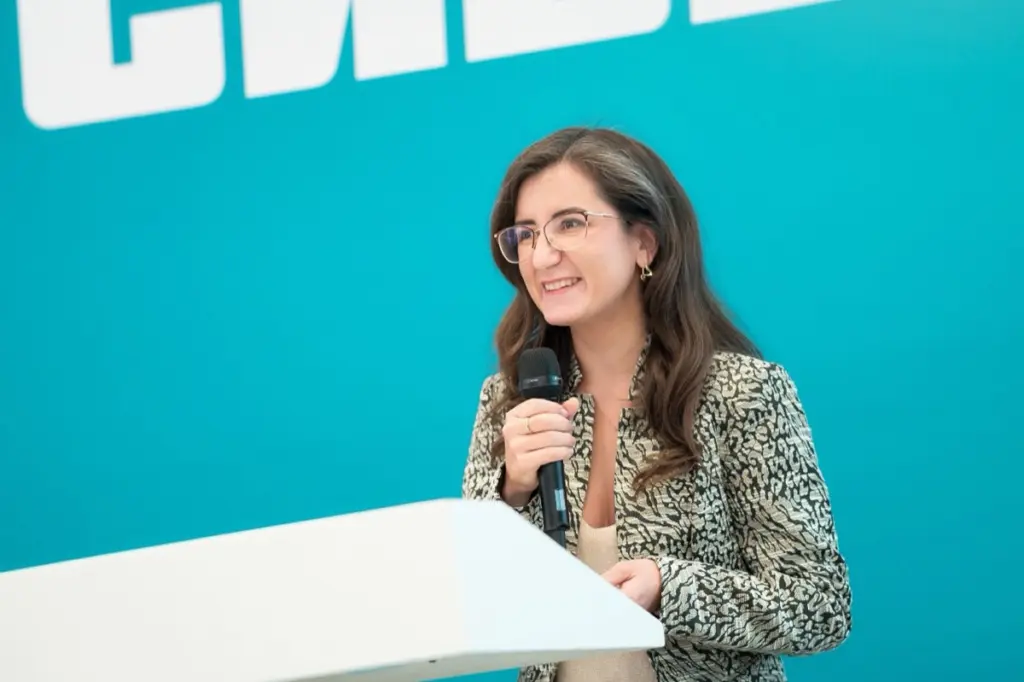
The 2nd International Forum «Islands of Sustainable Development: Climate and Ecology,» held on Sakhalin at the end of July 2026, reaffirmed once again that the climate agenda in Russia today is not a narrow environmental topic, but one of the key factors in regional competitiveness, governance quality, and economic resilience. For the Arctic and the Far East, this is particularly important, as it is here that climate, infrastructure, and economic challenges are most closely intertwined, says Milena Milic, a PORAI expert and Special Representative of the Governor of Sakhalin Oblast for Climate and Sustainable Development.
Russia’s first climate experiment turned Sakhalin into a practical testing ground where carbon regulation instruments were piloted: regional inventories of emissions and removals, quota setting, climate projects, a monitoring system, and interaction between the state, science, and business. The Sakhalin climate experiment is important not merely as a story of one region achieving carbon neutrality. It is Russia’s first practical experience in building a domestic carbon management system—from data and inventories to regulation, engagement with business, and result evaluation.
It is particularly telling that the forum’s discussions drew participation from regions engaged in implementing climate practices, including the Republic of Sakha (Yakutia) and Arkhangelsk Oblast. In these regions, the climate agenda has applied significance: it concerns territorial development, infrastructure resilience, economic adaptation to natural and climatic constraints, and the formation of their own low-carbon development models. This is fundamentally important for the entire northern arc of Russia, where universal solutions have limited applicability and require regional tuning.
For the Arctic, the climate agenda is directly linked to permafrost conditions, transport accessibility, energy reliability, the safety of populated areas, and the cost of any infrastructure solutions. Therefore, low-carbon development here cannot be considered separately from adaptation. What is needed is not only work on emission reductions but also a systemic policy to enhance the resilience of territories, economies, and governance systems to changing conditions.
In this context, the first experience of Sakhalin is valuable above all as proof that regional climate policy can be not declarative, but managerially coherent and economically meaningful. It is precisely comprehensive inventories, comparable data, clear rules, and business participation that create the foundation for decision-making. Without this, it is impossible to build trust in the climate agenda, attract investment, or scale up working mechanisms to other regions.
The issue of incentives deserves special attention. The transition to a low-carbon model in the northern and Far Eastern regions is impossible without support measures: preferential financing, tax instruments, support for energy efficiency, modernization of energy systems, and the introduction of technologies in remote and isolated grids. Where the cost of error is high and logistics are complex, climate policy must rely not only on regulation but also on economic mechanisms that make change realistic.
The Climate Club of Russian Regions, which unites subjects interested in the practical advancement of this agenda, is one of the platforms for harmonizing approaches between the Arctic, the Far East, and other territories. For me, as the Club’s Chair and a member of the Expert Council of the Project Office for Arctic Development (POAD), it is especially important that such platforms evolve into mechanisms for generating concrete solutions.
We will use the Sakhalin experience as a benchmark and a repository of knowledge and practices, rather than mechanically copying it. The next step is to adapt the proven tools to the northern and Far Eastern conditions, taking into account natural risks, economic structure, energy specifics, and the needs of the population. It is this approach that will make the climate agenda not a constraint, but a resource for the development of the Arctic and the Far East.
The Project Office for Arctic Development and the editorial board of GoArctic.ru do not necessarily share the opinions expressed by experts.
For media representatives: we welcome the republication of comments provided that an active link to the original source is given and the columnist’s status as an expert of the Project Office for Arctic Development is indicated.
Оthers Our comments
Vyacheslav Maracha: The Transit Potential of the Transarctic Transport Corridor Must Become the Main Growth Driver
The TTC – from a potential alternative to the Suez Canal route to a strategic necessity for global logistics The thesis that the Transarctic Transport Corridor (TTC) could become an alternative to the Suez Canal route for some Asian countries by reducing distance and shipping costs between Asia and Europe is commented on by Vyacheslav...
read more
Maksim Dankin Highlights Arctic Economic and Investment Potential to Indian Media
In an interview with an Indian The Print, PORA Director General Maksim Dankin highlighted promising avenues for economic collaboration between Russia and India within the Arctic region. The discussion encompassed potential strategies for bolstering bilateral trade relations. Interviewer: What economic opportunities does Arctic cooperation with Russia offer India in the current geopolitical situation? Maksim Dankin:...
read more