Home → Arctic 2035: Current Issues, Challenges, Solutions. Quarterly Scientific Journal
Arctic 2035: Current Issues, Challenges, Solutions. Quarterly Scientific Journal
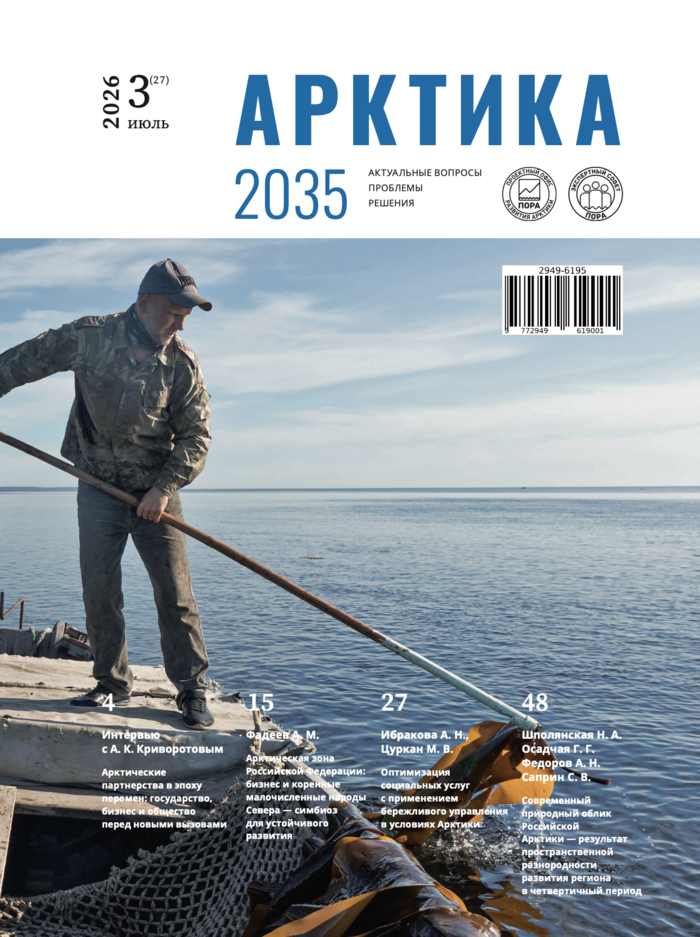
The theme of this issue — «Arctic Partnerships: State, Business, Society» — reflects one of the key trends in the modern development of the Arctic. In the context of large-scale economic, social, and environmental transformations, the search for effective mechanisms of interaction between government institutions, the business community, scientific organizations, and local communities is becoming particularly important.
Arctic Partnerships in a Time of Change: Government, Business, and Society Facing New Challenges
Interview with Andrey K. Krivorotov, Doctor of Economics, Acting Head of the Department at the Odintsovo Branch of MGIMO University of the Ministry of Foreign Affairs of the Russian Federation, Leading Research Fellow at the Institute of China and Contemporary Asia of the Russian Academy of Sciences, and Expert at the Project Office for Arctic Development (PORA)
This article examines the interaction between business and the Indigenous Peoples of the North in the context of sustainable development in the Arctic Zone of the Russian Federation. The study explores the current stage of Arctic development, characterized by the implementation of large-scale infrastructure, transportation, and resource extraction projects. Particular attention is paid to the role of business as a key driver of socio-economic development in Arctic territories and to the challenge of balancing the economic interests of resource companies with the rights and needs of Indigenous communities.
Drawing on Russian and international experience, particularly the practices of Norway and Canada, the article analyzes approaches to involving local communities in major industrial projects and establishing mechanisms for the distribution of socio-economic benefits derived from natural resource development. The paper also highlights the importance of corporate social responsibility as an instrument for improving living standards, supporting traditional economic activities, and preserving the cultural heritage of Indigenous peoples.
It is argued that sustainable development in the Arctic can only be achieved through long-term partnerships among the state, business, and local communities. Such an approach makes it possible to balance industrial development, the preservation of traditional ways of life, and the strategic objectives of Arctic development in Russia.
The Arctic Zone of the Russian Federation (AZRF) is characterized by specific conditions for the provision of social services, determined by severe climatic conditions, the remoteness of settlements, low population density, and limited resource availability. This article examines the potential of applying lean management principles to optimize processes in the social service sector.
Based on an analysis of practical experience in the regions of the AZRF, the study demonstrates that the implementation of lean technologies and lean management practices contributes to the reduction of organizational waste, improvement of institutional efficiency, and enhancement of service quality.
Special attention is paid to the opportunities and limitations associated with the implementation of lean approaches in the social sector, taking into account the distinction between front-office processes, which involve direct interaction with service recipients, and back-office processes, which provide administrative and organizational support for institutional activities.
The findings indicate the considerable potential of lean technologies to improve the sustainability and effectiveness of social service systems in the Arctic. The study substantiates the need for their further integration with digital management tools and infrastructure development projects implemented in northern regions.
The purpose of the article is to define the specific features of the application of lean technologies in the social service sector of the AZRF.
This article presents a forecast assessment of the prospects for establishing the Chukotka State Arctic University on the basis of the Chukotka Branch of M.K. Ammosov North-Eastern Federal University. The study is grounded in a landscape approach to the analysis of educational system development in the Arctic and aims to identify the institutional, socio-economic, and spatial factors necessitating the creation of an independent university in the region. An assessment of the current state of the scientific and educational complex of the Chukotka Autonomous Okrug reveals a number of key challenges, including a shortage of qualified personnel, population outmigration, the fragmented nature of the scientific and educational environment, limited infrastructure, and difficult transport and logistical conditions. Particular attention is paid to the role of higher education in ensuring the sustainable development of the region and supporting the implementation of Russia’s Arctic policy priorities. Based on a comparative analysis of Russian and international experience, the article proposes a hybrid university model combining a compact academic and research core in Anadyr, network-based educational technologies, a rotational faculty system, and a network of research and educational centers. Priority areas of educational, research, and sociocultural activity are identified, while key risks associated with the project’s implementation and mechanisms for their mitigation are outlined.
The natural environment of the Russian North is shaped by the widespread distribution of permafrost and associated cryogenic processes, which play a key role in the development of Arctic and Subarctic landscapes. The study of permafrost distribution patterns and cryogenic landforms provides valuable insights into the environmental history of the region and its potential future evolution. The aim of this article is to reconstruct the Quaternary history of the Russian Arctic and Subarctic based on an analysis of permafrost conditions and cryogenic relief features. The study reveals significant differences in the development of the western and eastern sectors of Northern Eurasia. It is demonstrated that natural processes and their sequence changed repeatedly throughout the Pleistocene in the western sector, whereas the eastern sector was characterized by relative environmental stability and continuity of natural conditions. The research also refines existing interpretations of Pleistocene glaciation in the Russian Arctic, showing that the Scandinavian Ice Sheet did not extend eastward beyond the Kanin Peninsula and that mountain-valley glaciers predominated outside this area. The findings suggest the persistence of stable environmental development in the eastern sector and a higher degree of natural variability in the western sector under future climatic fluctuations.
IMPLEMENTATION OF THE SOCIAL RIGHTS OF INDIGENOUS PEOPLES OF THE ARCTIC ZONE OF THE RUSSIAN FEDERATION IN THE CONTEXT OF INTERNATIONAL AND NATIONAL LAW
Indigenous peoples of the Arctic are increasingly facing challenges associated with climate change and the intensification of industrial development in the region. Rural indigenous communities are particularly vulnerable due to transport inaccessibility, geographic isolation, limited employment opportunities, and lower levels of socio-economic well-being. The purpose of this article is to analyze international and national legal mechanisms for the protection of indigenous peoples’ rights, with a particular focus on the situation of those residing in rural areas of the Russian Arctic.
The study is based on a formal legal analysis of international and Russian regulatory frameworks, including the United Nations Declaration on the Rights of Indigenous Peoples and relevant Russian legislation concerning the rights of Indigenous Minorities of the North. Statistical data and findings from field research were also examined.
The results indicate that a significant proportion of indigenous peoples continue to live in rural settlements, which are experiencing depopulation, youth outmigration, and declining socio-economic conditions. Although existing state support programs aim to improve living standards and preserve traditional ways of life, current measures remain insufficient to address ongoing demographic and social challenges. The article concludes that, alongside continued state support, modern media and digital communication tools can play an important role in preserving cultural heritage and strengthening the connection of younger generations with traditional indigenous lifestyles.
Public-private partnership (PPP) is one of the key instruments for attracting extra-budgetary investment to infrastructure development and the implementation of strategic projects. PPP mechanisms are particularly important in the Arctic Zone of the Russian Federation (AZRF), where the high capital intensity of projects is combined with challenging climatic conditions and limited public financial resources. The purpose of this study is to assess the extent to which PPP implementation practices in the Murmansk Region correspond to contemporary federal trends in the development of public-private partnerships.
The methodological framework of the research includes system analysis, analysis of regulatory documents and analytical reports, examination of official registers of PPP and quasi-PPP projects, and comparative analysis. The study focuses on two major federal trends: the expansion of PPP mechanisms aimed at strengthening technological sovereignty and the increasing role of VEB.RF in project evaluation and support.
The findings demonstrate that traditional concession agreements in the Murmansk Region are concentrated primarily in the housing and utilities sector, while projects related to industrial modernization and technological development are mainly implemented through quasi-PPP mechanisms, particularly Special Investment Contracts (SPICs). The study also identifies implementation risks associated with social concession projects and reveals discrepancies between official registry data and the actual status of several projects. The paper concludes that further PPP development in the region is most promising in the areas of industrial modernization, transport infrastructure, digitalization, and space-related activities.
This article examines the potential of green finance instruments to enhance the investment attractiveness of companies operating in the Russian Arctic Zone (AZRF) amid persistent regional development disparities and limited private investment inflows. Despite substantial government support and the strategic importance of the Arctic for Russia’s socio-economic development, the implementation of ESG principles and the attraction of sustainable financing remain highly relevant challenges.
The aim of the study is to determine the role of «green» bonds in the activities of companies in the AZRF and to develop recommendations for the application of ESG instruments to increase their investment appeal.
The methodological framework includes a theoretical analysis of the ESG concept and the regulatory framework governing «green» bonds in Russia, a comparative analysis of methodologies employed by leading Russian rating agencies, and an assessment of ESG rating dynamics based on RAEX data for the period 2021–2024.
The study evaluates Russian ESG rating systems, identifies the strengths and limitations of existing assessment methodologies, and analyzes the experience of leading ESG-oriented companies, including PhosAgro, Sberbank, and Norilsk Nickel. Particular attention is paid to the issuance of «green» bonds as a mechanism for attracting capital and promoting sustainable development. The findings demonstrate the feasibility of broader adoption of «green» bonds by companies operating in the AZRF as a means of strengthening their competitiveness and contributing to the sustainable development of northern territories.
ASSESSMENT OF TAX BURDEN CHANGES AND PROSPECTS FOR THE DEVELOPMENT OF SMALL AND MEDIUM‑SIZED ENTREPRENEURSHIP IN THE ARCTIC ZONE OF THE RUSSIAN FEDERATION
The Arctic Zone of the Russian Federation (AZRF) plays a crucial role in ensuring the country’s economic security and sustainable development. At the same time, small and medium-sized enterprises (SMEs) operating in the Arctic face a range of specific challenges associated with extreme climatic conditions, high logistics costs, labor shortages, and limited infrastructure. Under these circumstances, assessing the implications of the 2026 tax reform for Arctic businesses becomes particularly relevant.
The purpose of this study is to identify tax risks arising for SMEs in the AZRF as a result of changes in tax legislation and to develop practical recommendations aimed at enhancing their economic resilience.
The methodological framework of the research includes a comparative analysis of regulatory and legal documents, statistical data analysis, synthesis methods, and expert interviews. The study evaluates the potential impact of the planned tax changes on Arctic enterprises, examines trends in SME business activity, and provides a forecast for the future development of the region’s entrepreneurial sector.
The main outcome of the research is the development of a specialized checklist for the implementation of lean manufacturing tools adapted to Arctic conditions. The study concludes that a combination of targeted government support measures and operational efficiency improvement instruments is essential for ensuring the sustainable development of small and medium-sized businesses in the AZRF.
This review examines «Arctic. Pole of Color» (2025), a scholarly and artistic publication issued by the State Tretyakov Gallery as part of the exhibition project of the same name and dedicated to the 500th anniversary of the beginning of the Russian exploration of the Northern Sea Route. The publication represents an interdisciplinary study that brings together art-historical, cultural, and Arctic perspectives. Particular attention is paid to the role of visual art in shaping the image of the Arctic as an integral element of Russia’s cultural heritage and national identity. The review analyzes the book’s principal thematic sections devoted to artists who made a significant contribution to the artistic exploration of the North, including Konstantin Korovin, Alexander Borisov, Tyko Vylka, Konstantin Pankov, and representatives of Soviet Arctic art. The publication’s high scholarly quality, based on the research of specialists from the State Tretyakov Gallery, is highlighted, as is its contribution to the preservation and popularization of the cultural and historical heritage of the Arctic. It is argued that the volume transcends the format of a conventional exhibition catalogue and constitutes an important scholarly and educational work that offers new perspectives on the place of the Arctic in the history of Russian art, culture, and collective memory.