
Russia’s Arctic Shipping Ambitions: International Perspectives and Future Scenarios
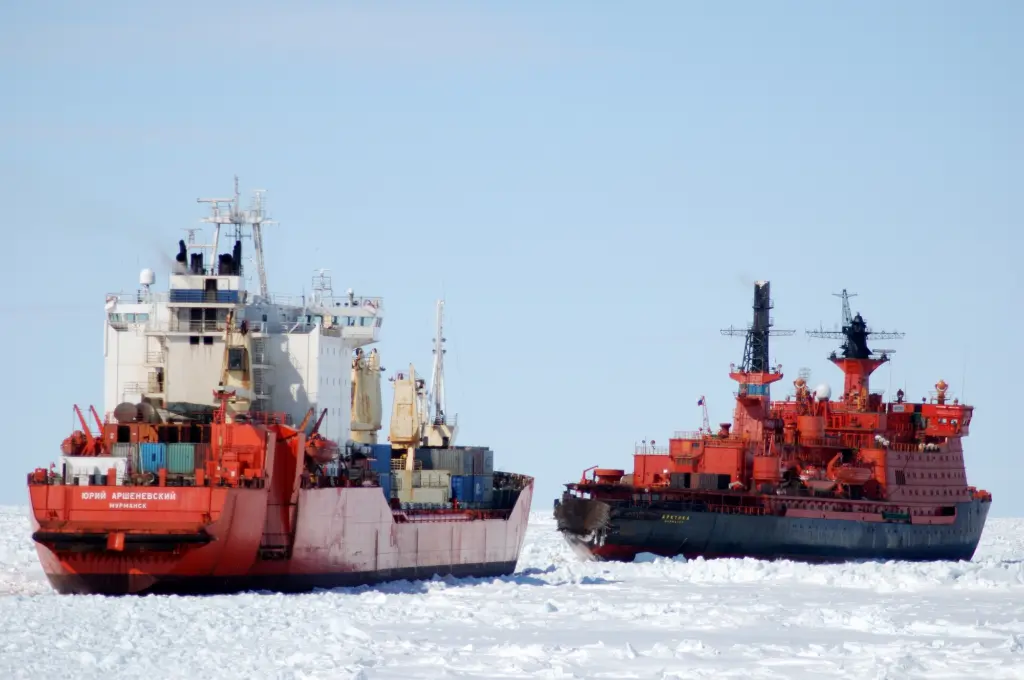
What do Russia’s international partners care about the most if the utilization of northern maritime corridors is concerned? What are the possible scenarios for the evolution of the NSR and the Trans-Arctic Transport Corridor through 2035?
Maksim Dankin, Director General of PORA, has noted that the future of these corridors will significantly depend on international partnerships, regulatory frameworks, and icebreaking fleet construction to enhance maritime activities in the region.
«Should Russia effectively address its fleet deficit and establish an effective management model for the Trans-Arctic Transport Corridor, the Arctic is poised to evolve from an «icy storehouse» into a global trade hub,» the expert noted.
NSR is evolving beyond its traditional perception as a route primarily relevant to Russia and China. The year 2025 has witnessed a surge in interest from different countries within the Asia-Pacific region and the Middle East. This heightened attention stems not only from considerations of logistics sovereignty and security but also from the vast economic advantages the route offers.
The NSR presents a considerably shorter distance between major trading hubs compared to traditional routes. The route between Shanghai and Rotterdam via the NSR is 8,000–8,500 nautical miles, compared to approximately 10,500 miles via the Suez Canal. This significantly reduces not only travel time but also fuel consumption—in some cases, up to three weeks—which aligns with international sustainable development initiatives such as low-carbon logistics.
India perceives the NSR as a strategic imperative crucial for the expansion of the Chennai-Vladivostok maritime corridor to diversify and ensure stable energy supplies. Its willingness to pursue the partnership along the Trans-Arctic Transport Corridor underscores New Delhi’s position amidst the risk of potential Western sanctions. Expert says that the NSR is a key element in achieving energy security and logistical sovereignty for India, rather than simply a commercially viable project.
Similarly, the United Arab Emirates, through its leading logistics provider DP World, is actively integrating into the Trans-Arctic Transport Corridor. The UAE aims to leverage the NSR to elevate the status of its key ports as central transshipment hubs for trade flows. Integrating the NSR into DP World’s extensive network will facilitate the redirection of substantial cargo volumes from the Global South to Europe via a secure northern route, thereby enhancing the logistics sovereignty and competitiveness of Emirati infrastructure within international trade.
Singapore is transitioning from mere observation to technological partnership in the Arctic projects. This includes participation in the construction of coastal infrastructure and icebreaking fleet. Advanced Asian economies recognize the Arctic as a promising market for exporting their engineering expertise.
Last but not least, participation in multilateral platforms such as BRICS and the SCO is driving interest in the Arctic among nations like Turkey, Saudi Arabia, and several other Gulf and Middle Eastern states. These countries seek to exploit this window of opportunity to strengthen their logistics capabilities and investment positions within the evolving Arctic landscape
Mr Dankin identified three possible scenarios for the NSR and the Trans-Arctic Transport Corridor by 2035
The first scenario
Termed «raw materials-based,» envisions the NSR remaining primarily a conduit for hydrocarbon transportation.
Traffic would be intermittent and dependent on new production capacity. This represents a «minimum» scenario, ensuring cost recovery but lacking global leadership.
The second scenario
Called «opportunistic transit». It posits that Asian partners utilize the NSR as a «backup airfield» when it is cost-effective or in case of disruptions to southern routes. Russia profits from icebreaker escorts, but does not fully integrate into global value chains.
The third scenario
It characterized as an «infrastructure breakthrough,» involves the development of a comprehensive corridor through modernization of hub ports, establishment of a container fleet, and creation of a digital logistics ecosystem.
In this scenario, the NSR emerges as a genuine competitor to southern routes, potentially capturing 10-15 percent of container traffic between Europe and Asia.
Authors

Оthers Our comments
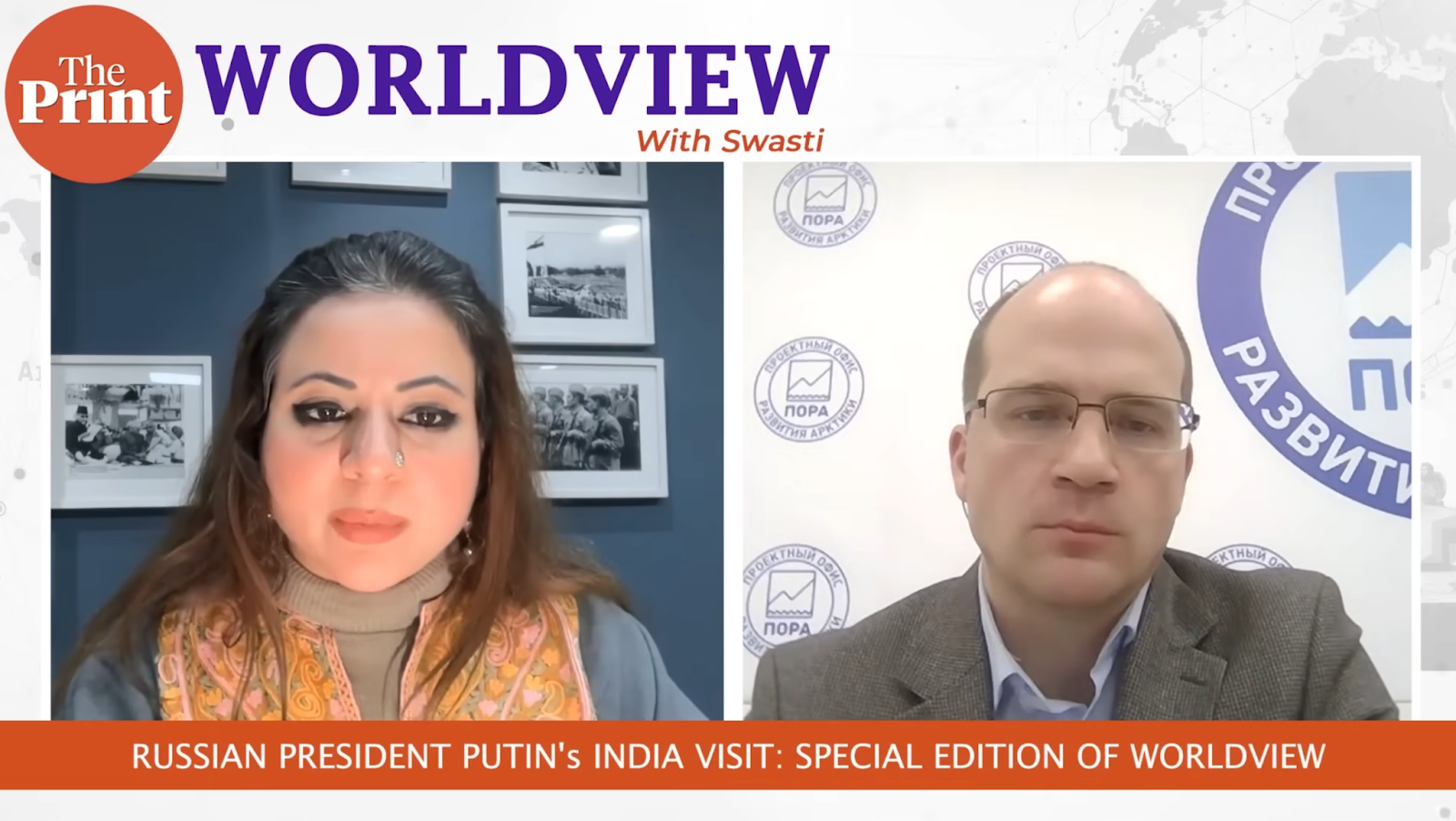
Maksim Dankin Highlights Arctic Economic and Investment Potential to Indian Media
In an interview with an Indian The Print, PORA Director General Maksim Dankin highlighted promising avenues for economic collaboration between Russia and India within the Arctic region. The discussion encompassed potential strategies for bolstering bilateral trade relations. Interviewer: What economic opportunities does Arctic cooperation with Russia offer India in the current geopolitical situation? Maksim Dankin:...
read more