
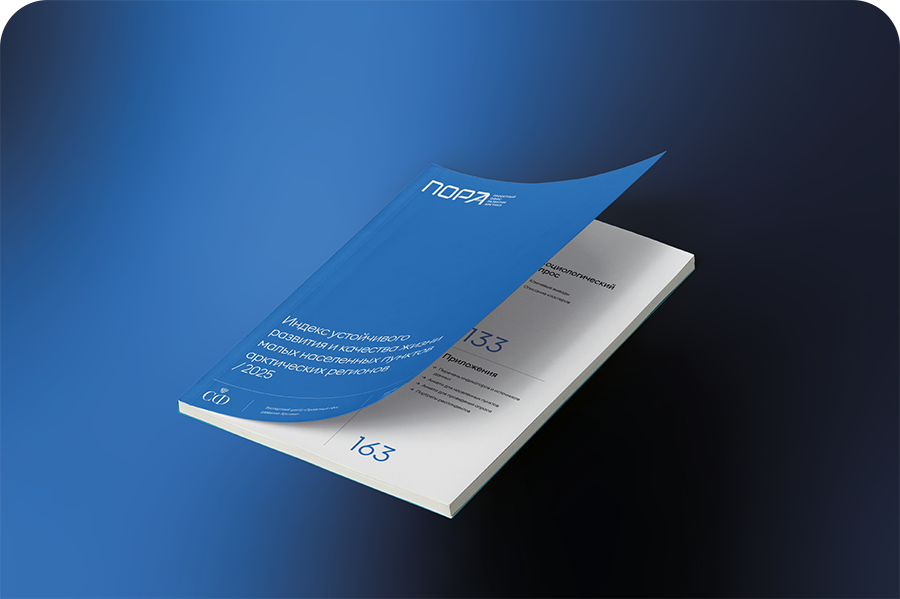
Index of Sustainable Development and Quality of Life in Small Arctic Settlements
The Index of Sustainable Development and Quality of Life in Small Arctic Settlements is the first comprehensive framework in Russia for assessing living conditions and sustainable development in small settlements of the Arctic Zone of the Russian Federation.
The research focuses on identifying territorial disparities in quality of life, infrastructure provision, access to basic services, and socio-economic opportunities at the level of individual settlements.
The Index provides an analytical foundation for targeted policy design and for monitoring progress toward strategic Arctic development goals by translating national priorities into a set of comparable and regularly updated indicators.
Context
The research was conducted as part of the analytical effort by PORA focused on assessing quality of life and sustainable development in Arctic territories. The study was initiated in response to the absence of regular, granular monitoring of small Arctic settlements, despite the fact that improving living conditions in these areas is defined as a key priority within Russia’s Arctic policy and strategic planning framework.
Methods
The study is based on up-to-date data collected and processed in 2024–2025. It aims to provide an evidence-based and balanced assessment of sustainable development and quality of life in small Arctic settlements, as well as to identify key risk areas and potential growth points. The methodology integrates objective and subjective components and encompasses 68 indicators grouped into core social, infrastructure, environmental, and economic domains. The analysis draws on 14 data sources, including official statistics, sectoral and municipal surveys, geospatial data, a representative sociological survey of 1,827 residents, and the analysis of approximately 60,000 social media comments. The results are presented through thematic maps, settlement profiles, grouped rankings, and analytical charts
Results
The Index reveals substantial variation in living conditions across small Arctic settlements and identifies persistent gaps in key areas such as income levels, access to healthcare, education quality, and infrastructure provision. In most settlements, the purchasing power of public-sector wages remains below the average level within the corresponding municipal economies, alongside ongoing shortages of medical and educational personnel. At the same time, the Index highlights best practices and leading settlements where combinations of infrastructure solutions and governance approaches support relatively higher quality of life. Overall, the findings provide a basis for targeted support measures and for assessing their effectiveness over time.
Discussion
The research does not aim to provide an exhaustive description of all aspects of Arctic territorial development and is limited by data availability and methodological choices. The analysis highlights systemic constraints in settlement-level statistical observation and underscores the need for further development of primary data collection and disclosure mechanisms. In the longer term, the Index may be institutionalized as a regular monitoring tool for tracking dynamics, assessing policy effectiveness, and supporting evidence-based territorial governance.
Authors

Оthers Our research

Quality of Life, Migration Intentions, and Perceptions of Public Policy in the Arctic
This study addresses population outflow from the Russian Arctic, a critical challenge to the region’s development.
read more
Inequality of Arctic Regions. Part I: Fiscal Capacity and Autonomy
This study evaluates disparities in the fiscal capacity of Arctic regions and the extent of their budgetary autonomy.
read more