
Arctic Cooperation: A Pathway to Renewed Russian-Korean Dialogue?
February 11, 2026

The IV International Scientific Conference The Arctic in Modern World Politics, organised by the Institute of Europe of the Russian Academy of Sciences, the G.A. Arbatov Institute for the U.S. and Canada Studies, and the Russian Center for Scientific Information focused on issues of strategic transformation in the Arctic, new geopolitical realities, and prospects for international cooperation.
Dr. Maria Lagutina, Editor-in-Chief of the Arctic 2035: Current Issues, Problems, Solutions journal, Goodwill Ambassador of the Northern Forum provided a systematic analysis of the Republic of Korea’s strategic motives in the Arctic at the session The Arctic as a Space for International Cooperation: Opportunities for Russia.
South Korea’s unique geoeconomic position, lacking direct land connections to major continental transport routes, necessitates a strong focus on maritime shipping lanes, including the Northern Sea Route. Seoul considers Arctic engagement not as a temporary foreign policy initiative but rather as an integral part of a long-term strategy aimed at diversifying its logistics and securing access to Eurasia’s resources.
Lagutina paid attention to the institutional framework of the Republic of Korea’s Arctic policy: obtaining observer status in the Arctic Council, the adoption of the Act on Promotion of Activities in Polar Regions (2021), the Strategy-2050, and the Basic Plan for the Promotion of Polar Activities for 2023–2027. This indicates Korea’s transition from the status of a «novice» to the category of a systemic and long-term Arctic actor.
Prior to 2022, Dr. Lagutina observed that relations between Russia and South Korea were characterised by a practical approach that minimised political considerations.
• participation of South Korean shipyards in the construction of Arc7 ice-class LNG carriers for the Yamal LNG and Arctic LNG-2 projects
• promotion of the Northern Sea Route as an alternative Asia-Europe route
• scientific cooperation in climate and oceanographic research
• the «Nine Bridges» concept, which included the NSR and shipbuilding among priority areas
The report allocated a distinct section to analyze the evolving nature of collaboration following 2022. The presenter highlighted that the Republic of Korea’s sanctions regime predominantly focuses on export controls and technological restrictions. These measures have demonstrably affected high-technology sectors within Arctic initiatives, particularly shipbuilding and the provision of specialized equipment and components. Consequently, South Korean corporations were forced to freeze or cease execution of a number of contracts, which reduced the predictability of bilateral interaction.
The speaker acknowledged that while sanctions have created strain on relations, they haven’t entirely eradicated shared interests. She characterized the current situation in the Arctic as a «zone of forced pause,» rather than an irreversible break.
In conclusion, the expert noted that the Arctic could become one of the first areas for the gradual restoration of Russian-Korean dialogue in the post-sanctions period. Despite current restrictions, the Arctic region retains strategic importance for both sides as a space of long-term economic and technological interest.
Оthers Our news
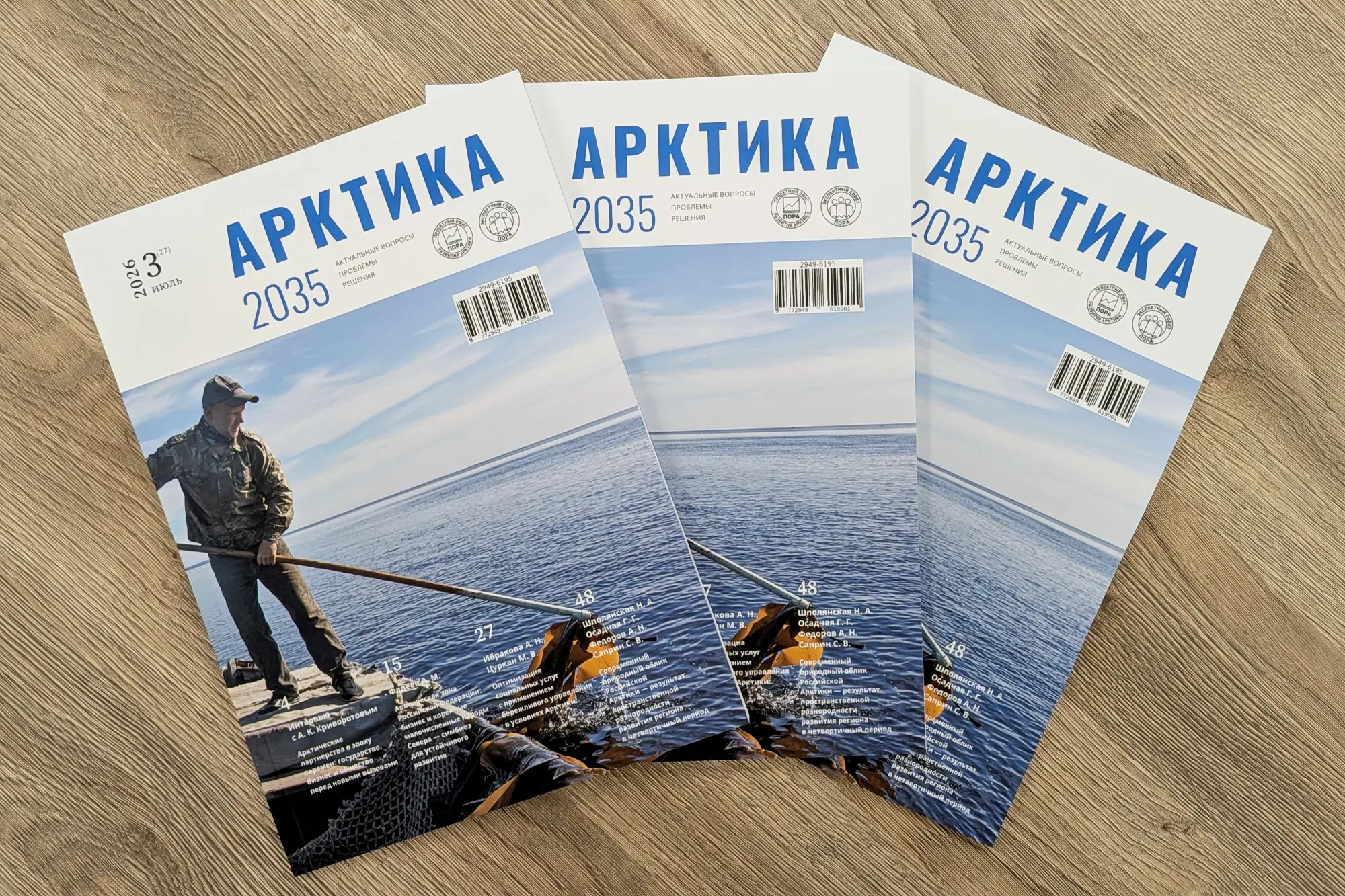
«Arctic 2035» new issue: state-business-society partnership for Arctic development
The theme of the issue is framed as «Arctic Partnerships: State, Business, Society» The latest issue of the scientific-practical journal «Arctic 2035: Current Issues, Problems, Solutions» — No. 3 (27) for 2026 — has been published. It can be read on the journal’s website, as well as in the electronic libraries eLibrary and CyberLeninka. The...
read more
PORA to Participate in Implementing the Sustainability Concept for Indigenous Minorities
By order of the Government, the action plan for the first phase of implementation (2026–2028) of the new Sustainability Concept for Indigenous Minorities of the North, Siberia, and the Russian Far East through 2036 has been approved.
read more