
Advancements Needed for Arctic Transportation Infrastructure, Logistics, and International Collaboration Discussed in Moscow
March 12, 2026
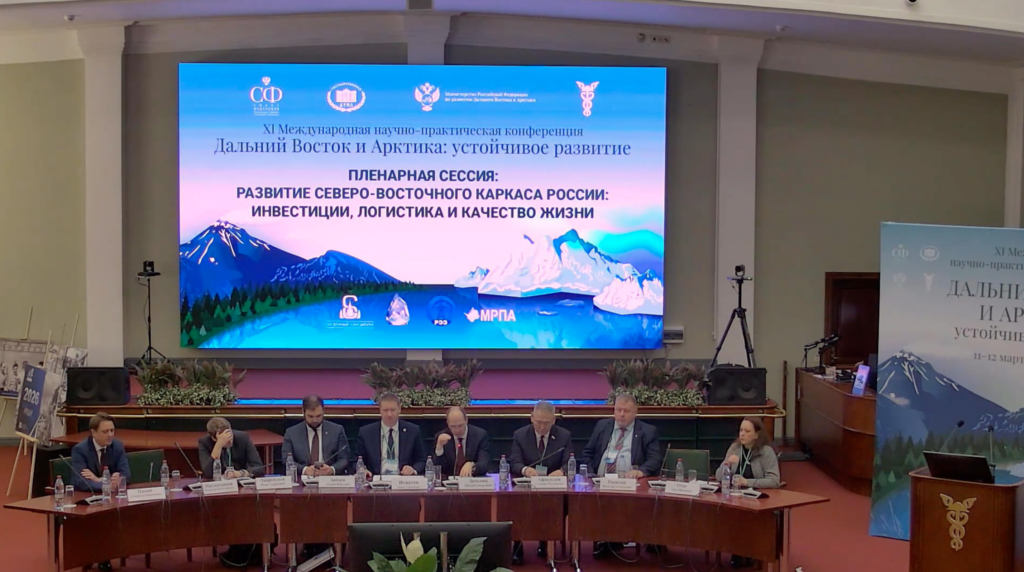
The XI International Scientific and Practical Conference «The Far East and the Arctic: Sustainable Development» commenced on March 11th at the Chamber of Commerce and Industry of the Russian Federation. The plenary session, moderated by Maksim Dankin, General Director of the PORA Expert Center, delved into key aspects of sustainable development in the Russian Arctic, specifically investment collaboration, the enhancement of logistical networks, and the elevation of living standards.
Challenges to International Cooperation
Vladislav Maslennikov, Director of the Department of European Issues at the Ministry of Foreign Affairs of the Russian Federation, underscored the imperative of recognizing Russia’s sovereign rights and interests within the Arctic region. He asserted that Western nations should foster an environment conducive to comprehensive and equitable dialogue with Russia, exhibiting a commitment to identifying mutually agreeable resolutions for regional development challenges.
It was highlighted that China and India are not merely expressing interest in Arctic collaboration but possess tangible capabilities to implement joint projects with Russia, particularly focusing on the advancement of the Northern Sea Route.
The Arctic is Competing for People
Alexander Panin, Director of the Center for Geodemography and Spatial Development at Lomonosov Moscow State University, analyzed international strategies for mitigating depopulation in northern regions. He highlighted that the Russian Arctic has experienced a significant population decline of 1 million people over the past three decades.
It was emphasized the limitations of traditional industrial approaches in attracting residents to Arctic cities. He advocated for exploring alternative functions beyond industry, suggesting economic diversification through the establishment of recreational zones and urban renewal programs. Furthermore, he stressed the crucial role of innovative technological solutions tailored for Arctic conditions.
Experts revisited the Soviet model of «great spatial integration» implemented in the 1980s, which correlated regional development levels with territorial and production clusters. They underscored that the Russian Arctic remains tethered to an industrial spatial framework and has yet to embrace a post-industrial paradigm.
Regional Projects to Ensure Infrastructure Connectivity
Andrey Zaytsev, Deputy Director of the Department of Regional Industrial Policy at the Ministry of Industry and Trade of the Russian Federation, presented an overview of regional initiatives aimed at enhancing connectivity infrastructure along the Northern Sea Route.
He emphasized the adequacy of the current icebreaker fleet to ensure safe navigation along the Northern Sea Route.
«The current icebreaker fleet in the Northern Sea Route waters consists of 12 vessels, including eight nuclear-powered icebreakers, which is sufficient to ensure safe navigation along the Northern Sea Route,»
— the expert noted
It was further highlighted ongoing shipbuilding projects, including the construction of three serial nuclear-powered icebreakers at the Baltic Shipyard and the Lider icebreaker at the Zvezda Shipbuilding Complex, as well as the development of 11 emergency rescue vessels.
The official commended the establishment of the Arctic Test Center in Salekhard, the sole facility in Russia where manned and unmanned aerial vehicles are simultaneously operated and maintained by specialists with expertise in manned aviation. This center’s infrastructure is envisioned to facilitate a flexible route network, ultimately leading to reduced transportation costs and accelerated cargo delivery.
Maksim Dankin added that the development of the Northern Sea Route and the Trans-Arctic Transport Corridor cannot be considered separately from the country’s entire logistics system.
«The development of a large territory is always linked to its transport, energy, and social connectivity. Therefore, the Northern Sea Route must be considered holistically – alongside the development of ports and the country’s entire logistics infrastructure,»
— Dankin concluded
The PORA Expert Center is the official partner of XI International Scientific and Practical Conference «The Far East and the Arctic: Sustainable Development» being held in Moscow on March 11-12, 2026.
Оthers Our news

PORA Discussed the Protection of the Rights of Indigenous Peoples of the North
Representatives from YNAO, Yakutia, and the Murmansk Oblast spoke at the discussion club meeting June 1, 2026 The «Project Office for Arctic Development» (PORA) Expert Center held a discussion club meeting titled «Protection of the Rights of Indigenous Peoples of the North and the Role of the State and Business in This Process.» The participants...
read more
The White Sea-Baltic Canal: A Strategic Asset in Need of Modernization
April 6, 2026 This article presents an analysis of potential upgrades to the White Sea-Baltic Canal, originally published by Maksim Dankin, General Director of the PORA Expert Center, in Vedomosti newspaper on April 1, 2026. With the consent of the editorial team, we are reprinting this analysis piece for our readership. In February 1931, the...
read more