
PORA counts: Is it possible to leave the Arctic and still remain in the North?
When a northerner says they are thinking about moving, people often think of the central or southern regions of the country, where the climate is milder, distances are shorter, and daily logistics are easier. But data shows that not every potential move out of the Arctic means a complete break with the North.
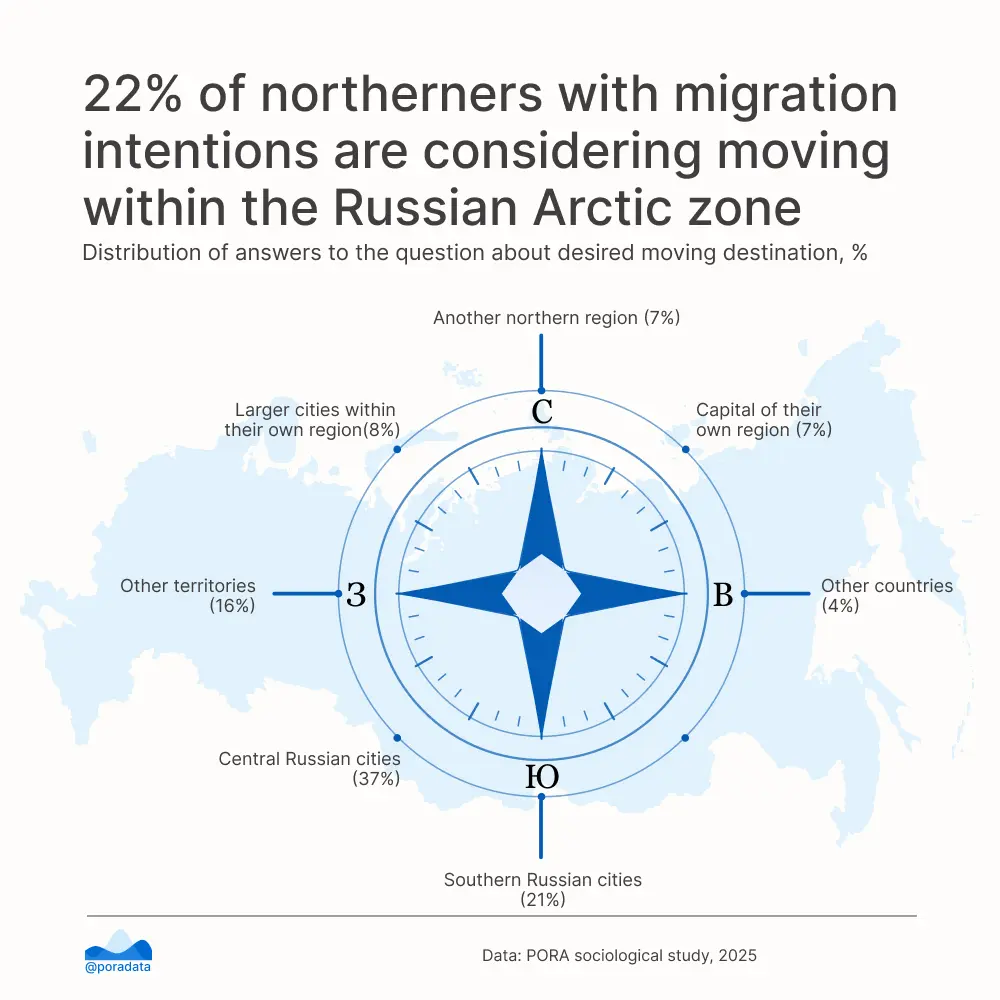
In a sociological study by PORА, respondents with migration intentions were asked where they would like to move.
The most popular destinations are predictable.
– 37.4% named central Russian cities;
– 21.2% — southern Russian cities.
Another 15.6% chose other territories, and 3.9% — another country.
At the same time, 8.2% of respondents are considering a larger city within their own region, 7.2% — the capital of their federal subject, and another 6.6% would like to move to some other northern region. And this is important: as one can easily see, one in five residents of the polar region who are thinking about leaving do not actually want to leave the Far North.
What is behind this?
The main reasons people consider moving are not only related to climate. Often, it’s about everyday living conditions: a lack of specialized medical professionals, high cost of living, salary levels, access to healthcare, and housing conditions. As for the North itself, it suits this category of people just fine.
What does this mean for the Arctic?
The goal is not always to keep a person in a specific town or city at all costs. Sometimes a more realistic approach is to ensure that they do not leave the macro-region entirely. If a northerner is already thinking about moving, it is important that the possible destinations include not only Krasnodar, St. Petersburg, or Moscow, but also polar region centers. From the perspective of regional policy, migration within the Arctic can be a way to preserve the population and human capital of the northern territories.
Оthers Our news
Gazprom Expands Its Arctic Potential: Record Gas Reserve Growth Driven by Arctic Fields
In 2025, Gazprom continued its systematic strengthening of its resource base, achieving its most significant results on shelf fields in the Arctic. This was reported by Chairman of the Management Committee Alexey Miller at the company’s Annual General Meeting of Shareholders. In 2025, the Gazprom Group once again achieved a gas reserve replacement ratio above...
read more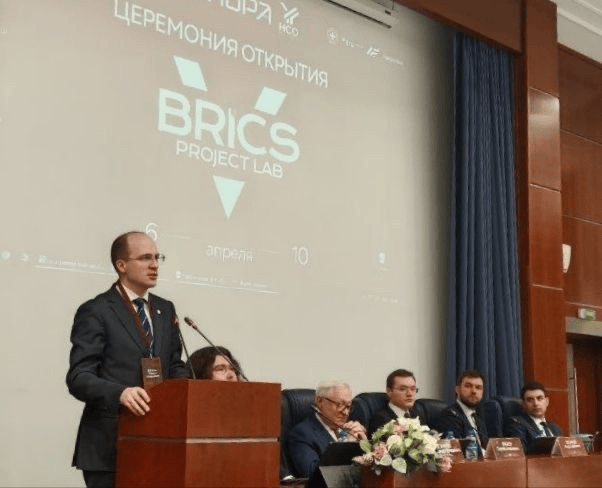
Maksim Dankin Speaks to Participants of BRICS Project Lab
The 5th International Youth BRICS Project Lab has transitioned to its in-person phase at MGIMO University. Following two weeks of remote collaborative work on their respective projects, participants have convened for a five-day program encompassing expert presentations, facilitated discussions, and the refinement of proposed solutions. The inaugural ceremony was graced by the presence of Sergey...
read more