
Maksim Dankin Highlights Arctic Economic and Investment Potential to Indian Media
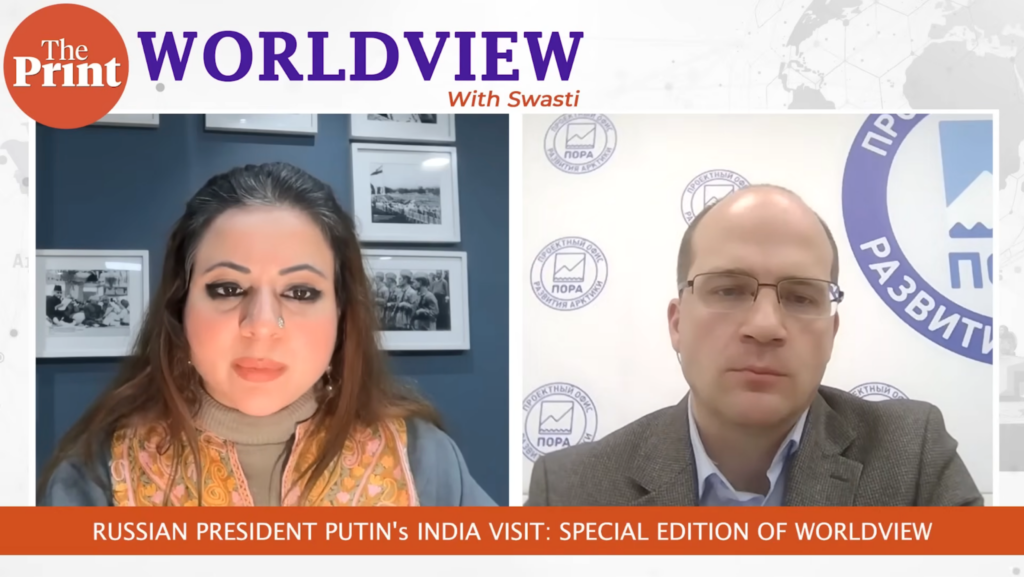
In an interview with an Indian The Print, PORA Director General Maksim Dankin highlighted promising avenues for economic collaboration between Russia and India within the Arctic region. The discussion encompassed potential strategies for bolstering bilateral trade relations.
Interviewer: What economic opportunities does Arctic cooperation with Russia offer India in the current geopolitical situation?
Maksim Dankin: The first is trade. India is one of Russia’s most important trading partners and markets for Russian products. The Arctic is rich in energy resources and critical metals, including rare earth metals.
India is one of the world’s fastest-growing economies. Your energy consumption is growing at a very rapid pace. Russia already provides 40% of India’s oil imports.
I believe that these figures will continue to grow. There is a potential for growth in this area.
The second area is investment, or to be more specific, investment niches.
The President of Russia has supported the initiative to develop a new comprehensive project, «The Arctic and the Trans-Arctic Transport Corridor,» an integral part of which is the Northern Sea Route. This comprehensive project includes not only the launch of new mining projects in the Arctic, but also creating the logistics infrastructure along the Trans-Arctic Transport Corridor which involves seaports, multimodal transport hubs at the junction of railways and river and sea routes, as well as other access infrastructure, and the infrastructure of key Arctic cities. Given the Russian Government’s interest and commitment to implementing many projects through a public-private partnership model with the possibility of attracting foreign capital, I believe this opens up opportunities for Indian partners to participate in these projects, with the potential to make a profit.
The third important area is shipbuilding. Today, given the pace of cargo traffic growth on the Northern Sea Route and the overall development of the Arctic zone of the Russian Federation, there is a rapidly growing demand for various sea and river vessels, including ice-class vessels. Russia could be a reliable and long-term customer for Indian shipyards, thereby ensuring their workload and economic stability. Negotiations between the governments of our nations are already vigorous in this sector.
The fourth area is labour migration. Today, Russia is experiencing a shortage of personnel in industry and infrastructure projects, including those in the Arctic. India is considered one of the leading exporters of labour, especially qualified specialists and workers. Large Arctic construction projects create demand for skilled employees, and the average salary in Russia remains attractive for these specialists. I think there are also opportunities for cooperation in this regard.
The fifth is science.
“The Arctic is the ‘kitchen of the world’s weather’. We know about the relationship between climatic processes in the Arctic and the Himalayas and their impact on various natural phenomena around the world, including natural disasters. This matter is particularly vital for India, where floods and the amount and quality of precipitation have a direct impact on economic activities”
Russia, meanwhile, possesses significant capabilities for conducting atmospheric, climatic, and glaciological research and forecasting in these areas. India is also engaged in similar research, operating its own research station, Himadri, in Svalbard. I believe that the development of joint research will serve the interests of both India and Russia.
Interviewer: What are the prospects for investment cooperation between Russia and India in the Arctic? What projects is Russia interested in? For example, the construction of new LNG plants, the development of Northern Sea Route infrastructure, the participation of Indian investors in the development of the railway network in the Arctic Zone of the Russian Federation, and the investment potential of Siberia?
Maksim Dankin: As I have already said, investment cooperation in the Arctic is one of the most promising areas of Russian-Indian partnership. The potential for growth in this area is substantial. Russia is consistently developing large industrial and energy projects in the Arctic, including LNG plants, such as Yamal LNG, Arctic LNG 2, exploiting metal, oil and coal fields, expanding terminal infrastructure in Sabetta and Murmansk, and infrastructure facilities to develop the Trans-Arctic Transport Corridor, including the Northern Sea Route.
Opportunities are expanding in the transport infrastructure accessing the NSR, notably through the development of the Northern Latitudinal Railway and Belkomur.
Siberia, rich in mineral resources, forestry, and logistics potential, presents a viable entry point for Indian investments.
Let me return to the point when answered the first question. The withdrawal of numerous Western investors and businesses from Russia has created favorable opportunities for forging partnerships with more pragmatic partners, such as India. There is a potential to yield mutually beneficial outcomes and maximize profitability for all stakeholders involved in prospective ventures.
Interviewer: How do you assess the current state and prospects for the development of bilateral trade along the Chennai-Vladivostok route and the international North-South Transport Corridor? What are the existing trade restrictions? What conditions are necessary for further growth of trade between the two countries?
Maksim Dankin: First, I’ll cover the prospects for the International North–South Transport Corridor. Although this route has been under consideration since the early 2000s, it has gained significant momentum for development since 2021, partially because of Suez Canal blockage at that time. Today, freight turnover on this route is growing by 30-40 per cent annually. The international transport corridor itself has three routes: a western route traversing Azerbaijan and Iran, an eastern route through Kazakhstan and Turkmenistan, and a Caspian route directly from Russia to Iran via the Caspian Sea. Transiting through Iran and transshipping in Bandar Abbas by sea, the route reaches India and back.
This is the shortest route between our countries, and potentially between India and European markets.
While there is significant potential for development, there are some challenges to be addressed. First, the construction of the Resht-Astara railway, the missing link in Iran. Russia is one of the investors in this project, with an anticipated completion date of 2028.
Another challenge is the different railway gauges in Iran and the countries of the former USSR.
Finally, the aging river-sea fleet suffers from low container capacity.
Nevertheless, modernization efforts along the International North–South Transport Corridor are expected to result in a more than twofold increase in cargo traffic by 2030.
“As far as the Chennai-Vladivostok route is concerned, it presents a promising alternative for trade between Russia and India, with the added benefit of serving as a connecting route to the Trans-Arctic Transport Corridor through Vladivostok. Nevertheless, this route requires further development to establish a cargo base and implement additional incentives that will encourage shippers to utilize it, thereby ensuring the economic efficiency of cargo transportation”
Unfortunately, such transportation is not very cost-effective at present. Therefore, focused development efforts could render this route mutually beneficial for both Russian and Indian economies.
Interviewer: India plans to connect more routes to the Chennai-Vladivostok route. For example, it plans to connect this route to the ports of Visak and Paradip, which are located in eastern India. Russia has also proposed including countries such as Thailand, Vietnam and Indonesia as stopover points to strengthen regional integration. Do you think these plans are feasible in the near future?
Maksim Dankin: I believe that this is a crucial task and, in many ways, a solution that could increase the efficiency of the Chennai-Vladivostok route, as I mentioned earlier about the lack of cargo base and the low economic efficiency of such routes.
The involvement of countries of the Asia-Pacific region in the Chennai-Vladivostok trade route will, firstly, increase the volume of cargo and, secondly, improve the efficiency of its transportation. Currently, it is one of the tools to improve the efficiency of this route.
For Russia, this facilitates the increase in volume of goods imported not only from India, but also from Vietnam, which you mentioned, and other countries in the region.
Similarly, for India, this means additional opportunities to increase efficiency and, at the same time, additional markets for its products in neighbouring countries.
Full interview is available here
Authors

Оthers Our comments
Proxy Governance Model for Greenland: An Option for the U.S. Foreign Policy?
Alexander Pilyasov, Doctor of Science (Geography) and Professor at Lomonosov Moscow State University, proposes that Donald Trump could leverage proxy organizations to manage economic activities and resources in Greenland. Drawing on historical precedents such as the Hudson’s Bay Company, the East India Company, and the Tennessee Valley Corporation, Dr. Pilyasov highlights the effectiveness of this...
read more
Achieving Arctic Development Targets by 2026 — A Foundation for a New Stage of Social and Economic Growth
February 27, 2026 In the run-up to Arctic Day, the Director General of the PORA Expert Center, Maksim Dankin, assessed the results of the social and economic development of the Russian Arctic over the past five years. Speaking at the round table devoted to the strategic priorities for the development of the Russian Arctic Zone...
read more