
«Arctic 2035» new issue: state-business-society partnership for Arctic development
The theme of the issue is framed as «Arctic Partnerships: State, Business, Society»
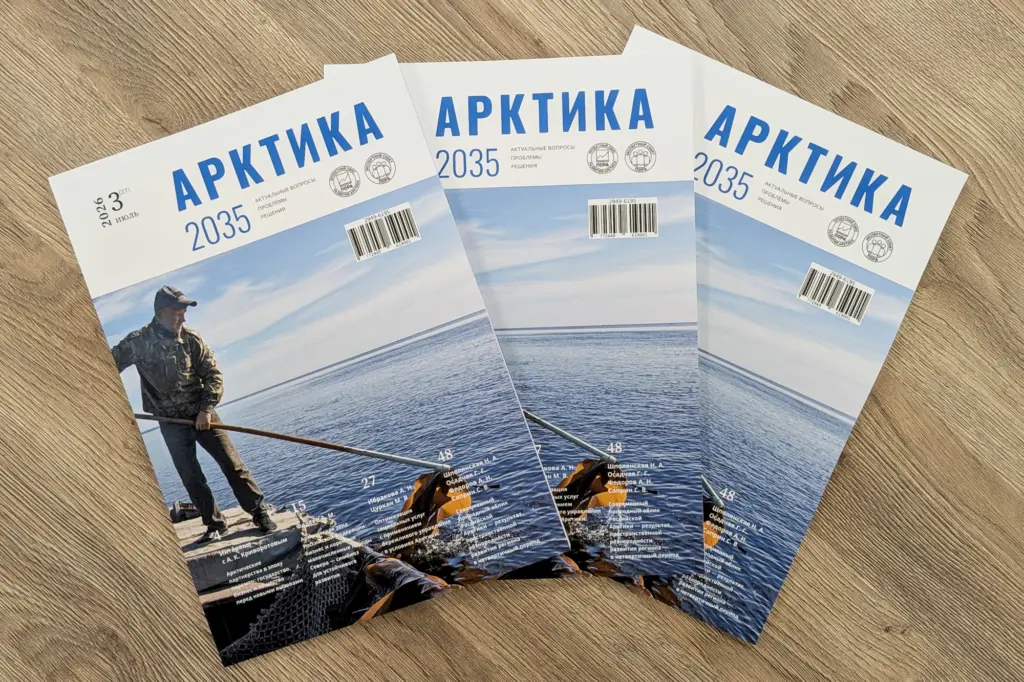
The latest issue of the scientific-practical journal «Arctic 2035: Current Issues, Problems, Solutions» — No. 3 (27) for 2026 — has been published. It can be read on the journal’s website, as well as in the electronic libraries eLibrary and CyberLeninka.
The authors examine the development of the Russian Arctic as a multifaceted challenge at the intersection of economics, public administration, law, ecology, education, and social policy. The materials in this issue are devoted to public-private partnerships, sustainable financing, the implementation of ESG principles, the protection of the rights of indigenous small-numbered peoples of the North, the improvement of social services, the development of Arctic education, and the study of the region’s natural features. The issue also launches a new section, «A Word to Young Experts,» intended for publishing research by emerging specialists.
«In the context of large-scale economic, social, and environmental transformations, finding effective mechanisms for interaction between state institutions, the business community, scientific organizations, and local communities becomes particularly important,» notes the journal’s editor-in-chief, Maria Lagutina.
According to the scientific editor, Alexander Vorotnikov, «issues of sustainable development of the Arctic Zone of the Russian Federation lie at the intersection of politics, economics, law, ecology, education, and the social sphere, which makes an interdisciplinary approach to the study of Arctic processes especially relevant.»
CONTENTS OF THE ISSUE
A. K. Krivorotov. Arctic Partnerships in a Time of Change: Government, Business, and Society Facing New Challenges
In an interview, Doctor of Economic Sciences Andrey Krivorotov analyzes the current stage of development of the global and Russian Arctic. He examines intensifying geopolitical competition, sanctions pressure, technological transformation, the changing role of the state, and prospects for cooperation with BRICS countries. Special attention is paid to public-private partnerships, corporate social responsibility, interaction between industrial businesses and indigenous peoples, depopulation of northern territories, and new formats of international cooperation. The expert notes that the development of the Arctic must combine large-scale investment projects with the development of local business, social infrastructure, and human capital.
A. M. Fadeev. The Arctic Zone of the Russian Federation: Business and Indigenous Peoples of the North – A Symbiosis for Sustainable Development
The author explores the interaction between industrial companies and indigenous small-numbered peoples of the North amid the active development of the Arctic Zone of the Russian Federation. Drawing on Russian experience as well as practices from Norway and Canada, the article shows how large resource projects can contribute to the development of local economies, employment, infrastructure, and professional competencies of the population. Corporate social responsibility is viewed not as charity, but as an essential part of a long-term business strategy. Sustainable development of the Arctic, in the author’s view, requires ongoing partnership between the state, companies, and local communities, consideration of the interests of indigenous peoples, and support for traditional economic activities.
A. N. Ibrakova, M. V. Tsurkan. Optimization of Social Services Using Lean Management in Arctic Conditions
The article examines the application of lean management principles in social service organizations within the Arctic Zone of the Russian Federation. The authors take into account the region’s characteristic constraints: remoteness of settlements, low population density, resource scarcity, complex logistics, and harsh climatic conditions. An analysis of practical experience in Arctic regions shows that lean technologies can reduce organizational losses, streamline processes, increase institutional efficiency, and improve the quality of services provided. At the same time, successful implementation of such approaches requires adaptation of standard tools to regional specifics and staff training.
V. M. Savvinov, T. E. Alekseeva, L. A. Neustroev. Predictive Evaluation of the Arctic University Model in Chukotka
The authors assess the prospects for establishing the Chukotka State Arctic University on the basis of the Chukotka Branch of the North-Eastern Federal University named after M. K. Ammosov. The need for an independent university is linked to staff shortages, migration outflows, fragmentation of the scientific and educational environment, lack of infrastructure, and the region’s transport isolation. A hybrid university model is proposed, combining a compact scientific and educational core in Anadyr, network educational technologies, a rotational teaching staff, and a system of research and education centers. The article also identifies the main areas of work for the future university, possible project risks, and ways to mitigate them.
N. A. Shpolyanskaya, G. G. Osadchaya, A. N. Fedorov, S. V. Saprin. The Modern Natural Appearance of the Russian Arctic is a Result of the Spatial Heterogenety of the Region’s Development in the Quaternary Period
This study examines the formation of natural landscapes in the Russian Arctic and Subarctic under the influence of permafrost and cryogenic processes. The authors reconstruct the region’s history during the Quaternary period, comparing the distribution of frozen ground, landforms, and the consequences of repeated climate changes. It is shown that the modern natural appearance of the Arctic developed unevenly: different territories underwent varying stages of glaciation, freezing, and thawing. This spatial heterogeneity is important not only for understanding the region’s past but also for assessing possible changes in Arctic landscapes under current warming conditions.
E. Dolzhenkova. Implementation of the Social Rights of Indigenous Peoples of the Arctic Zone of the Russian Federation in the Context of International and National Law
The author analyzes international and Russian legal mechanisms for protecting indigenous small-numbered peoples of the Arctic. Special attention is paid to residents of rural and remote areas, who face transport isolation, limited access to social services, job shortages, and demographic challenges more acutely than others. The article examines provisions of the UN Declaration on the Rights of Indigenous Peoples and norms of Russian legislation. The author demonstrates that formal enshrinement of rights is insufficient: effective mechanisms for access to education, healthcare, employment, and infrastructure are needed, as well as support for traditional nature use, languages, and cultural identity of northern peoples.
E. D. Kiryushina, A. M. Vorotnikov. Federal Trends in Public-Private Partnerships and Their Manifestation in the Murmansk Region
The article examines the alignment of public-private partnership (PPP) practices in the Murmansk Region with all-Russian trends. The authors view PPP as an important means of attracting extra-budgetary funds to infrastructure and strategic projects, particularly significant for the Arctic given its high construction costs and limited budget resources. Concession agreements, classical and quasi-PPP projects, as well as the expansion of partnership mechanisms into new areas are analyzed. Using the Murmansk Region as an example, the article shows how such instruments are used in transport, utilities, social, and other infrastructure, and identifies which institutional constraints hinder more active private capital attraction.
K. A. Ivantsova, E. E. Maksimchuk, A. A. Sulkhaeva kyzy, K. S. Izmodenova. Integration of ESG Factors into the Development of Enterprises in the Arctic Zone of the Russian Federation Through the Use of «Green» Bonds
The authors examine green bonds as a tool for attracting private investment into the environmental modernization of enterprises in the Arctic Zone of the Russian Federation. Despite the region’s strategic importance and substantial state support, the implementation of ESG principles and sustainable financing remains limited. The article analyzes opportunities for directing raised funds toward emission reduction, energy efficiency improvements, adoption of cleaner technologies, and reduction of environmental risks. The use of green bonds can simultaneously enhance the investment attractiveness of Arctic companies, improve corporate governance quality, and link enterprise economic development with measurable environmental outcomes.
S. A. Novoseltseva, K. S. Izmodenova. Assessment of Tax Burden Changes and Prospects for the Development of Small and Medium-Sized Entrepreneurship in the Arctic Zone of the Russian Federation
The article examines the consequences of the 2026 tax reform for small and medium-sized businesses in the Russian Arctic. The authors note that entrepreneurs in the region already operate under conditions of high logistics costs, staff shortages, weak infrastructure, and a limited domestic market, so an additional tax burden could accelerate the decline in the number of enterprises and reinforce the territory’s resource-based specialization. Alongside risk assessment, the article proposes state support measures and tools for improving operational efficiency. In particular, a special checklist for implementing lean production has been developed, including loss diagnostics, process optimization, and standardization of improvements with consideration of Arctic specifics.
O. V. Podshuveit. Book Review: ‘Arctic. Pole of Color’. Moscow: State Tretyakov Gallery, 2025. 184 p.
The review is devoted to the scholarly-artistic publication of the State Tretyakov Gallery, prepared as part of the eponymous exhibition marking the 500th anniversary of Russia’s exploration of the Northern Sea Route. The book combines art criticism, historical-cultural, and Arctic approaches, and tells the story of the formation of the visual image of the Russian North from the 19th to the 21st century. The focus is on works by Konstantin Korovin, Alexander Borisov, Tyko Vylko, Konstantin Pankov, Soviet, and contemporary artists. The reviewer assesses the publication simultaneously as a scientific atlas and an art album, allowing readers to see the history of Arctic exploration, the life of indigenous peoples, and the region’s natural diversity through the lens of art.
The journal Arctic 2035: Current Issues, Challenges, Solutions is dedicated to the comprehensive study of the Arctic Zone of the Russian Federation. Its founder and publisher is the Expert Center — Project Office for Arctic Development. The journal is registered with Roskomnadzor and has ISSN 2949-6195. It is published in print and is also available electronically.
Оthers Our news

PORA counts: Is it possible to leave the Arctic and still remain in the North?
When a northerner says they are thinking about moving, people often think of the central or southern regions of the country, where the climate is milder, distances are shorter, and daily logistics are easier. But data shows that not every potential move out of the Arctic means a complete break with the North. In a...
read more
Gazprom Expands Its Arctic Potential: Record Gas Reserve Growth Driven by Arctic Fields
In 2025, Gazprom continued its systematic strengthening of its resource base, achieving its most significant results on shelf fields in the Arctic. This was reported by Chairman of the Management Committee Alexey Miller at the company’s Annual General Meeting of Shareholders. In 2025, the Gazprom Group once again achieved a gas reserve replacement ratio above...
read more