
The Fourth Issue of Arctic 2035 for 2026 Marks the Northern Forum’s 35th Anniversary
This special issue brings together research on the Northern Forum’s history, interregional partnerships, and new avenues for international cooperation
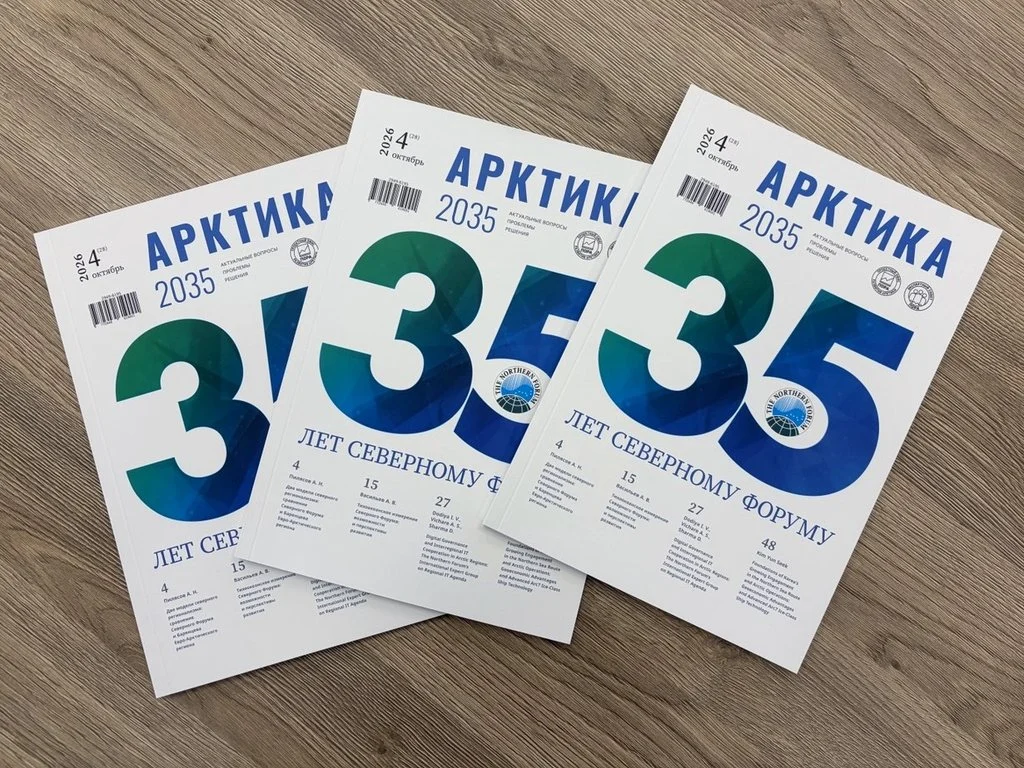
A special issue of the academic and practice-oriented journal *Arctic 2035: Current Issues, Challenges, Solutions* (No. 4 (28), 2026) has been published to mark the 35th anniversary of the Northern Forum, an international organization that promotes interregional cooperation and brings together representatives of northern and Arctic territories. The Forum’s latest meetings are taking place in Yakutsk on October 7–10, 2026.
The contributors examine the Northern Forum’s role in sustaining international dialogue, exchanging knowledge, and advancing practical cooperation amid geopolitical changes. The issue covers the organization’s history, models of northern regionalism, engagement with Asia-Pacific countries, the sustainable development of local communities, climate diplomacy, digital governance, and scientific and educational initiatives. It features contributions from authors in Russia, the United States, China, India, the Republic of Korea, and Japan.
“Today, as the traditional architecture of international engagement in the Arctic undergoes profound transformation, flexible formats that help maintain professional ties, expert dialogue, and practical cooperation are becoming particularly important,” notes Maria Lagutina, the journal’s Editor-in-Chief and a Northern Forum Goodwill Ambassador.
Vladimir Vasiliev, Executive Director of the Northern Forum, served as the issue’s Guest Scientific Editor. According to him, the organization seeks to “find new formats and tools to support and develop international and interregional cooperation, expand its geographical reach, and bring its activities to the global level.”
Contents of the Issue
V. N. Vasiliev. “The Role of the Northern Forum in International Cooperation in the Arctic under Conditions of Turbulence”
In this interview, Northern Forum Executive Director Vladimir Vasiliev explains how the organization is adapting to changes in the international environment while maintaining its mission of improving quality of life and supporting the sustainable development of northern regions. Particular attention is paid to expanding ties with Asian countries, participating in the international climate agenda, and advancing scientific and educational initiatives. He discusses the prospects for an Arctic-Pacific platform, cooperation among seaports, and the development of the Northern Sea Route as part of the Trans-Arctic Transport Corridor.
A. S. Kirillov. “The Northern Forum: 35 Years of International Interregional Cooperation in the Arctic”
The author traces the Northern Forum’s history and changes in its organizational structure, programme priorities, and membership geography. Drawing on founding documents, General Assembly declarations, Board of Governors resolutions, and academic publications, the article identifies stages of emergence, growth, crisis, and adaptation. It examines the role of regional diplomacy in maintaining international ties and outlines scenarios for further development. The author demonstrates that the Northern Forum retains its potential for cooperation as a channel for dialogue between regions, even when traditional international formats are constrained.
A. N. Pilyasov. “Two Models of Northern Regionalism: A Comparison of the Northern Forum and the Barents Euro-Arctic Region”
The article compares two approaches to organizing cooperation among northern territories. The Northern Forum is viewed as an open network of regions built on knowledge exchange and the capacity to reshape the geography and formats of engagement. Barents cooperation is characterized by territorial contiguity, a combination of intergovernmental and interregional levels, and a denser project and financing infrastructure. The author examines the resilience of both models to external crises and links the Northern Forum’s prospects to the development of a global network of regional diplomacy, the transfer of northern knowledge, and support for new interregional projects.
A. V. Vasiliev. “The Pacific Dimension of the Northern Forum: Opportunities and Prospects for Development”
The author explores opportunities to expand the Northern Forum’s cooperation with Asia-Pacific territories. The importance of this direction is linked to changes in international engagement in the Arctic and the development of the Russian Far East, the Northern Sea Route, and the Trans-Arctic Transport Corridor. Promising areas include transport and logistics, energy, climate and the environment, scientific and technological cooperation, healthcare, and cultural and humanitarian ties. The article proposes organizational mechanisms for building a network of regional, expert, and institutional partnerships.
Paul Fuhs. “Fulfilling the Promise of the Arctic Council: A People-centred Framework for Arctic Sustainable Development”
In this essay, the author examines how the Arctic Council’s sustainable development objectives can be translated into a coherent agenda focused on the well-being of northern residents. This approach brings together viable local economies, environmental protection, infrastructure, education, and institutional cooperation. Particular attention is paid to community resilience, responsible economic development, and security. The Northern Forum is viewed as an organization capable of complementing the Arctic Council’s work by connecting general principles with the practical experience of northern regions.
O. V. Sanarova. “Intersectoral Partnership as a Mechanism for Sustainable Development of Arctic Territories: The Case of the Anabar National Dolgan-Evenk Municipal District of the Republic of Sakha (Yakutia)”
Using the Anabar District as a case study, the author examines cooperation among public authorities, businesses, non-profit organizations, the scientific community, and local communities, including representatives of the Indigenous small-numbered peoples of the North. The research draws on materials from a field expedition to Saskylakh and Yuryung-Khaya, expert interviews, documents, and observations. The article explores the role of the Northern Forum and its partners in bringing together resources, expertise, and local knowledge. It considers how such cooperation can support climate adaptation, preserve traditional natural resource use, develop digital infrastructure, and promote ethno-ecological tourism.
A. V. Kirgizov-Barskii. “UNFCCC Conferences of the Parties as a Platform for Arctic Cooperation: The Arctic Pavilion Experience and the Prospects of Its Implementation at COP31”
The article explores opportunities to advance the Arctic agenda at the Conferences of the Parties to the United Nations Framework Convention on Climate Change (UNFCCC COPs). The author examines the Arctic Pavilion’s experience and its potential as a space for engagement among states, regional authorities, scientific organizations, businesses, and Indigenous peoples when regional cooperation mechanisms are operating in a limited capacity. The article proposes a typology of the pavilion’s functions and offers recommendations for establishing a sustained Arctic presence in the international climate process. Particular attention is paid to the prospects for implementing this format at COP31.
I. V. Dodiya, A. S. Vichare, D. Sharma. “Digital Governance and Interregional IT Cooperation in Arctic Regions: The Northern Forum’s International Expert Group on Regional IT Agenda” (in English)
The authors examine the work of the International Expert Group on Regional IT Agenda, established within the Northern Forum in 2023. A comparison of nine digital indicators across eleven member regions reveals disparities that cannot be addressed solely by expanding broadband internet access. The article proposes an approach to assessing IT governance capacity in extreme environments and introduces the DAIM framework (Define, Analyze, Innovate, Materialize), encompassing problem definition, analysis, innovation, and the implementation of solutions. The expert group is viewed as a promising mechanism for interregional digital cooperation.
Wang Wen. “China and the Arctic: Historical Evolution, Current Cooperation, and Future Trends” (in English)
The author traces the development of China’s Arctic policy from scientific research to broader participation in economic cooperation and Arctic governance. The article identifies four stages of this evolution and examines engagement with Russia and the Nordic Arctic states, the development of the Ice Silk Road, and the opportunities and constraints facing these partnerships. The Arctic’s importance to China is analysed through the issues of climate, transport, and energy security, technological development, and global governance.
Kim Yun Seek. “Foundations of Korea’s Growing Engagement in the Northern Sea Route and Arctic Operations: Geoeconomic Advantages and Advanced Arc7 Ice-Class Ship Technology” (in English)
The author examines the foundations for the Republic of Korea’s expanding participation in Arctic projects. The analysis focuses on legislative mechanisms supporting the Arctic Route, Busan’s potential as a hub port within a multi-port model, and Korean shipyards’ expertise in building Arc7 ice-class vessels. The Northern Sea Route is considered in connection with the development of ports, shipbuilding, and related industries. Alongside enabling conditions, the author assesses structural constraints and the risks of secondary sanctions that affect the prospects for implementing Korea’s Arctic strategy.
Hide Sakaguchi. “Science Diplomacy in the Arctic: Prospects for Russia–Japan Scientific Cooperation on the Northern Sea Route” (in English)
The essay explores the potential of science diplomacy to maintain engagement between Russia and Japan in the Arctic. The author examines differences between the two countries’ approaches to regulating navigation along the Northern Sea Route and emphasizes the importance of a scientific basis for navigational and environmental safety. Promising areas include joint expeditions, scientific data exchange, and researchers’ participation in scientific programmes, including projects involving Japan’s new Arctic research vessel, Mirai II.
I. A. Strelnikova. “Spitsbergen as a Space for International Scientific and Educational Cooperation: The Experience of the First HSE University Summer School”
The review examines the first HSE University International Summer School, held on Spitsbergen in June 2026 in partnership with the Northern Forum and Arktikugol. The author discusses the objectives and organizational model of the school, which brought together Russian and international students, experts, and representatives of Arctic organizations. Particular attention is paid to combining academic training, field research, and practical problem-solving in international cooperation and Arctic tourism. The summer school is viewed as a promising recurring format for developing scientific and educational ties in the Arctic.
Arctic 2035: Current Issues, Challenges, Solutions is devoted to the comprehensive study of the Arctic Zone of the Russian Federation. Its founder and publisher is the Expert Centre — Project Office for Arctic Development (PORA). The journal is registered with Roskomnadzor, holds ISSN 2949-6195, and is published in both print and electronic formats.
Оthers Our news
PORA to Support National Project «Environmental Well-being»
Initiatives by the Project Office for Arctic Development (PORA) and the environmental movement «Friends of the Environment» (DOM) have become part of the national-level environmental agenda On May 19, 2026, Russian Minister of Natural Resources and Ecology Alexander Kozlov outlined the key directions of Russia’s environmental policy through 2030 during parliamentary hearings on the implementation...
read more
PORA Discussed the Protection of the Rights of Indigenous Peoples of the North
Representatives from YNAO, Yakutia, and the Murmansk Oblast spoke at the discussion club meeting June 1, 2026 The «Project Office for Arctic Development» (PORA) Expert Center held a discussion club meeting titled «Protection of the Rights of Indigenous Peoples of the North and the Role of the State and Business in This Process.» The participants...
read more