
Vladislav Maslennikov: Arctic Remains a Core Priority for Russia
March 4, 2026
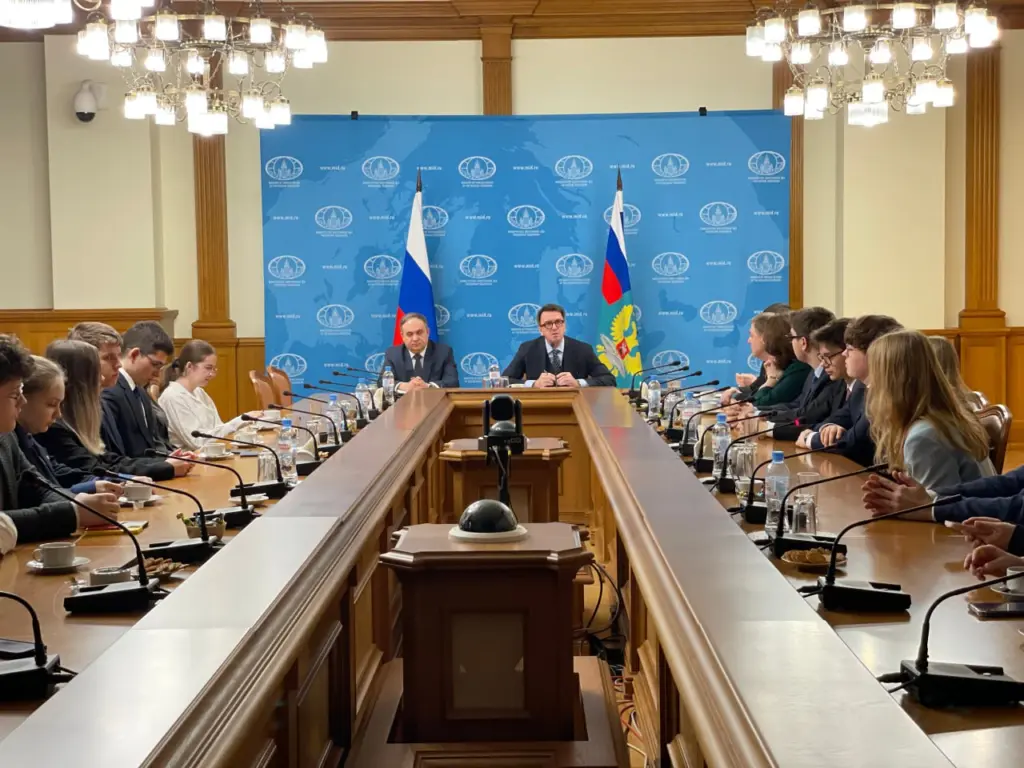
Vladislav Maslennikov, Director of the Department of European Issues, the Ministry of Foreign Affairs of the Russian Federation, Senior Russian Official in the Arctic Council, gave his assessment of the current international situation in the Arctic, including the Northern Sea Route (NSR) and the Arctic Council, during a meeting with students at the Diplomatic Academy of MGIMO University. Below is the full text of his speech. Full script is available below (in Russian).
I am pleased to welcome you to the Ministry of Foreign Affairs of the Russian Federation and to have this opportunity to tell you about one of the many areas of our work – the Arctic. As I understand it, this topic is close and interesting to many of you.
For our country, the Arctic remains one of the main priorities – both from the perspective of addressing the crucial tasks of socio-economic development of the Arctic zone of the Russian Federation, and international cooperation in the Far North as a whole.
Unfortunately, the general increase in tension between Russia and the West has not spared the polar region either. To date, the Arctic is not a source of geopolitical turbulence, but the processes and events occurring in other parts of the world certainly leave their mark on the situation in the region. Previously, the postulate «High Latitudes, Low Tension» was often featured in the documents and rhetoric of Arctic states. Unfortunately, today it no longer reflects the real situation.
Over the past few years, we have witnessed a reckless militarization of the Arctic region by NATO countries and an increase in the scale of military exercises. The illegitimate sanctions pressure on our country continues to grow, including measures designed to hinder the development of the Russian Arctic. All this does not contribute to strengthening stability in the region. And along with the curtailment of contacts with Western countries and a decrease in the level of mutual trust, it even increases the risks of unintended escalation.
The desire of a number of states to «contain» Russia in the Arctic also has very negative consequences for the entire world community. International cooperation in the North, collaboration in the field of emergency prevention and response, search and rescue, fisheries, ecology and environmental protection, and research activities have all come under attack.
It is obvious that under the current circumstances, continued cooperation with traditional partners among the Western Arctic states is very difficult, and in some areas practically impossible. Despite this, Russia will continue to address its pressing tasks in the North, relying primarily on its own capabilities. We possess all the necessary resources – natural, human, and scientific – for this.
At the same time, we will continue to adhere to the guidelines formulated in the Concept of the Foreign Policy of the Russian Federation of 2023 – to strive for maintaining peace and stability, reducing threats to national security, increasing environmental sustainability in the North, and ensuring favorable external conditions for the socio-economic development of the region, including in the interests of protecting the rights of indigenous peoples.
«We remain open to interaction in the high latitudes with all constructively minded partners, with the understanding that any dialogue must be based on respect for the sovereign rights and interests of our country in the Arctic. This position is reflected in our strategic planning documents on the Arctic and has been repeatedly stated by the Russian leadership and representatives of the Ministry of Foreign Affairs of the Russian Federation. This certainly applies to Western countries as well, if they realize the need to return to an equal dialogue with us, aimed at finding joint solutions to common issues in the Arctic,»
- the official emphasized
At the same time, we do not intend to wait for favorable weather by the sea. Therefore, on the Arctic track, we are working with those who are ready for this today, including non-regional states. In recent years, their interest in cooperating with Russia in the North has only grown. Primarily, China and India – major international players – are showing activity in this area. They not only declare their interest in the Arctic agenda but also possess extensive resources for implementing joint projects and initiatives with our country in the region. Our partners are seeking to enhance interaction on a wide range of topics, including mineral extraction, logistics, shipping, innovation, scientific cooperation, personnel training, and the exchange of competencies valuable for Arctic economic activities.
We also see potential for developing applied cooperation with other non-regional states and will strive to realize it, taking into account available opportunities.
Russian Strategic Documents on the Arctic
Russia’s policy in the Arctic, along with the aforementioned Foreign Policy Concept, is based on two other strategic planning documents: the Fundamentals of the State Policy of the Russian Federation in the Arctic for the Period up to 2035 and the Strategy for the Development of the Arctic Zone of the Russian Federation and Ensuring National Security for the Period up to 2035.
In February 2023, due to changes in the geopolitical situation, amendments were made to these documents – including the section on international cooperation. Instead of directly mentioning the Arctic Council and the Barents Euro-Arctic Council, the wording now used is «development of relations with foreign states on a bilateral basis and within the framework of relevant multilateral structures and mechanisms.»
At the level of relevant federal agencies – primarily the Russian Ministry for the Development of the Far East and the Arctic – work is underway to further update these documents in order to align them with current realities and the longer-term tasks facing Russia on the Arctic track.
An unwavering priority for us is ensuring the sustainable socio-economic development of the Russian Arctic and the well-being of people living in the polar region, including indigenous peoples. To this end, active work is carried out utilizing both domestic mechanisms and international interaction to most effectively address transboundary issues, including those related to climate change.
In this regard, I would like to particularly highlight our country’s extensive experience in protecting the rights of indigenous small-numbered peoples of the North. These issues are regularly discussed at relevant international platforms, and Russia’s positive experience in this area is actively promoted, including abroad. The examples of major Russian companies operating in the high latitudes, such as Alrosa, Novatek, Nornickel, and others, are telling. Many of them have their own operational documents on interaction with indigenous communities, based on generally accepted international standards in this area, such as free, prior, and informed consent regarding projects affecting their interests and lands. Businesses also often finance social, infrastructural, and cultural projects aimed at improving the well-being of indigenous peoples.
The Arctic Council
As I already mentioned, the situation in the North is not simple. At the instigation of Western countries, a number of once important and useful mechanisms of regional cooperation have degraded. In response to the hostile actions of Western countries, Russia withdrew from the Council of the Baltic Sea States and the Barents Euro-Arctic Council. Cross-border cooperation programs with Nordic countries, dialogue at the level of local authorities were «curtailed,» and established research and educational ties, as well as contacts between indigenous peoples, were disrupted.
The Arctic Council remains the main and, in fact, the only preserved format for multilateral interaction in the high latitudes. Over nearly 30 years of its work, the AC has gained the status of the most authoritative forum for international cooperation in the Arctic, largely due to its unique structure.
The AC unites eight Arctic states – Denmark, Iceland, Canada, Norway, Russia, the USA, Finland, and Sweden – as well as six «Permanent Participants» – organizations representing indigenous peoples living in the Arctic. Permanent Participants can engage in all stages of the AC’s work, put forward their initiatives, and implement projects. However, the decisive voting right remains with the AC member states, and the AC operates on the principle of consensus. Another important nuance of the Council’s work is that military security issues are excluded from its purview. This was stipulated from its very inception, in the founding Ottawa Declaration of 1996.
The key areas of interaction within the AC include monitoring, climate issues, environmental protection, pollution control, biodiversity conservation, emergency prevention and response, sustainable socio-economic development, and the protection of rights and preservation of the culture, languages, and traditional way of life of indigenous peoples. The bulk of the practical work in these areas is carried out within six working groups, which include specialized representatives from all Arctic states. The results of this activity are subject to approval at the political level.
Three intergovernmental agreements operate under the auspices of the AC: the Agreement on Cooperation on Aeronautical and Maritime Search and Rescue in the Arctic (2011), the Agreement on Cooperation on Marine Oil Pollution Preparedness and Response in the Arctic (2013), and the Agreement on Enhancing International Arctic Scientific Cooperation (2017).
Due to the current geopolitical situation, the AC today, unfortunately, is not in its best shape. In March 2022, the «Arctic Seven» Western countries announced the temporary suspension of their participation in the organization’s activities. This time coincided with the period of the Russian chairmanship of the organization in 2021-2023. Of course, this introduced certain adjustments to our plans, especially since Western countries refused to send their representatives to Russia for official AC events. However, we managed to almost fully implement the program of the Russian chairmanship, with an emphasis on achieving national goals and objectives for the development of the Arctic zone of the Russian Federation. About 90 forums, conferences, round tables, cultural and sporting events were organized on our territory, involving both individual constructively-minded representatives of Western Arctic states and non-regional countries (Belarus, Brazil, India, China, the Republic of Korea, and others).
Since 2022, there have been gradual shifts towards restoring the Council’s activities, mainly with the aim of unblocking its work at the expert level. Since last year, meetings of the AC’s subsidiary bodies have resumed online. This allows for the continued implementation of some previously approved projects, as well as the proposal and approval of new initiatives.
At the same time, the full-format work of the AC remains «frozen.» Western countries directly state that they are not yet ready to resume the political dialogue interrupted on their own initiative. Meetings of the Council’s main coordinating body, the Committee of Senior Arctic Officials, are still not held, and the Council’s Project Support Instrument is not functioning. Nevertheless, following the 14th Session of the AC held on May 12, 2025, a joint statement by all Arctic countries was adopted. It emphasizes the desire to maintain peace and security in the region and the importance of further strengthening the Council’s role as a key platform for multilateral cooperation in the Polar region. It is also indicative that all AC members still declare their interest in preserving the organization in its current composition and status.
«We believe that to maintain the AC authority and its attractiveness as a platform for interaction among leading experts on Arctic issues, the Council must demonstrate its effectiveness and ability to respond promptly and coherently to emerging challenges in the region. The current situation within the organization certainly does not contribute to this. Therefore, we are convinced that a return to the full-format work of the AC would benefit not only the Arctic states but also the entire international community. We continue to pursue this, maintaining contacts with the current Danish chairmanship of the organization and the AC Secretariat, conveying our position to them. This does not mean, however, that we seek participation in the AC «at any cost.» We will shape our further line primarily based on Russia’s national interests and depending on the real readiness of the other Council member states to work together,»
- the official noted
Speaking of the AC, one cannot fail to mention the Observers in the organization. This status can be granted to non-Arctic states, as well as intergovernmental, interparliamentary, and non-governmental organizations that meet a number of criteria. These include supporting the goals of the AC, respecting the sovereignty, rights, and jurisdiction of the Arctic states, willingness to contribute to the development of cooperation in the region, and possessing the necessary experience and resources. Observers can participate in AC meetings, the activities of working groups, and engage in projects under the Council’s auspices.
Currently, 13 countries have Observer status in the AC – Great Britain, India, Spain, Italy, China, the Netherlands, Poland, the Republic of Korea, Singapore, France, Germany, Switzerland, Japan – as well as 25 organizations. Many of these countries have extensive research capabilities and experience, including in the Arctic field, and possess sufficient resources to make a meaningful contribution to AC projects. For our part, we encourage constructive participation in projects by Observers, especially those from friendly countries such as China and India.
At present, due to the limited level of activity in the AC, the consideration of new Observer applications is on pause. The resumption of this process is directly linked to the restoration of political dialogue, as decisions on granting Observer status are made at the level of Foreign Ministers.
Northern Sea Route
Another important direction for Russia in the Arctic is the development of the potential of the Northern Sea Route (NSR), including through international interaction with partners interested in this.
The NSR is the shortest sea route between Europe and Asia through the waters of the Arctic Ocean, with its path running through the territorial sea and exclusive economic zone of Russia. The route has long been actively used for domestic transportation between different parts of Russia located along our northern coast. But in recent years, its advantages for international, including transit, transportation, such as cargo carriage between Europe and Asia, have become increasingly evident.
Amidst growing geopolitical turbulence, the Northern Sea Route is becoming an attractive alternative to traditional intercontinental routes. Its advantages include shorter length, associated economic benefits, and reduced shipping emissions due to the shorter distance traveled. An equally important aspect is the higher level of safety of this route, free from piracy and the negative impact of armed conflicts in coastal territories. The physical safety of navigation along the NSR, considering the challenging Arctic conditions, is ensured by Russia’s unique icebreaker fleet in terms of its capabilities, as well as the continuous development of infrastructure – port, search and rescue, and satellite monitoring of weather and ice conditions. In practical terms, a large amount of work in this area is carried out by the State Atomic Energy Corporation Rosatom and the Ministry of Transport of Russia.
I can give a concrete example. A container ship traveling from China to Britain via the NSR takes 18 days. By rail, it would take no less than 25 days, via the Suez Canal – 40 days, and around the Cape of Good Hope – more than 50 days.
Additional prospects are opening up in connection with the inclusion of the NSR within the framework of the initiative launched last year to develop the Trans-Arctic Transport Corridor – a «mega-project» that will connect Europe and Asia through the Russian Arctic, combining sea, rail, and road transport.
Against this backdrop, it is not surprising that interest in interacting with our country on the development of the Northern Sea Route is steadily growing, especially from our non-regional partners. Particularly notable here are China and India, whom I mentioned earlier. Both of these countries express their readiness and interest in using the NSR for transit transportation, cooperate with us within specially created working bodies, and plans have been outlined with Beijing and New Delhi to achieve concrete results in terms of cargo transportation volumes using this route.
- Full script is available here (in Russian)
The Project Office for Arctic Development does not always share the opinions expressed by experts.
For media representatives: we welcome republication of comments provided that an active link to the original source and the columnist’s status as an expert of the Arctic Development Project Office are indicated.
Оthers Our comments
Alexey Fadeev: A Russian Arctic Perspective on the US National Energy Dominance Council
March 24, 2026 The now-famous slogan «Drill, baby, drill,» which originally emerged in 2008, became a central element of Trump’s energy platform, emphasizing a focus on fossil fuels. The Energy Dominance Council was created as a unified headquarters to radically accelerate resource extraction and exports. It is worth noting that, thanks to a well-executed resource...
read more
Irina Strelnikova: The XVIII BRICS Summit and the Development of Cooperation in the Arctic
The bet is on the gradual accumulation of institutional mass, and the Arctic remains in the strategic focus of the association’s member countries On 12–13 September 2026, the XVIII BRICS Summit was held in New Delhi (India), timed to coincide with the 20th anniversary of the association, when in September 2006 the foreign ministers of...
read more