Climate change in the Arctic is no longer a subject of exclusively scientific debate — today, it is shaping the public policy agenda, transforming economic models, affecting the social sphere, and demanding a rethinking of international cooperation. The Arctic acts as a kind of «barometer» for global climate processes, where the consequences of climate change manifest more quickly and acutely than in other regions of the planet.
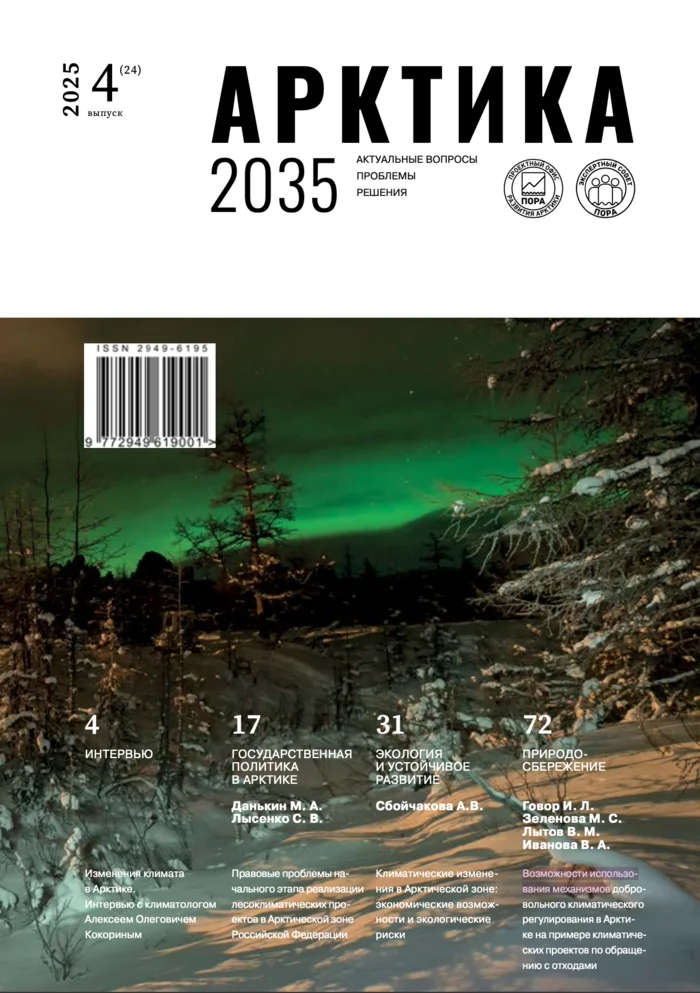
The Arctic region represents a key priority for Russia's foreign and domestic policy, while climate change is one of the most pressing global challenges of our time. The aim of this study is to identify Russia's key strategic priorities in the region regarding climate change. The study employs systemic and comparative analysis based on statistical data, national targets, and relevant strategic acts. The author concludes that Russia recognizes environmental damage and the need for global action and is prepared to advance research and measures for adaptation and technological carbon absorption of emissions. However, despite participating in most international initiatives, it is not a leader and remains a significant polluter. Key strategic documents highlight not only the disadvantages of climate change in the Arctic but also some advantages, such as cargo transportation, offshore development, etc. The state's activities are severely constrained by current foreign policy interests, the high share of mineral resources in its export structure, and the need to develop the Northern Sea Route. The practical significance of the study lies in its systematic explanation of the country's motivation, which allows us to predict its future activity in the Arctic.
This article examines the practical aspects of identifying legal issues in the implementation of a forest climate project during the preparation of an agreement with the Federal Forestry Agency (Rosleskhoz). It addresses the specifics of implementing forest climate projects in the Arctic Zone of the Russian Federation (AZRF), the interaction between the project initiator, government agencies, and economic entities, as well as the procedures that forest climate project initiators must follow at the initial stage of project implementation. The study employs an analytical method to examine current legislation governing the legal aspects of climate projects in general and forest climate projects in the Arctic in particular. Synthesis, modeling, and abstraction were used to analyze practical examples of the behavior of forest (land) rights holders within the scope of forest climate project implementation. Observation, measurement, and experimentation were applied to develop a practical framework for the initial stage of forest climate project implementation and to identify deficiencies in current legislation in the context of interactions with project stakeholders. As a result of the study, several shortcomings in current legislation were identified, and proposals for their elimination were formulated.
This article is of practical significance for potential climate project initiators and for government agencies that regulate relations in the field of climate initiatives in the Russian Federation. The authors of this article are practitioners and project organizers leading the first forest climate project in the Arctic Zone of the Russian Federation.
The scientific goal of the research is to comprehensively analyze climate change in possible opportunities and environmental risks in the Arctic zone of the Russian Federation, as well as to determine the relationship between the development of the region in the context of growing climatic and anthropogenic challenges. The article examines the consequences of climate change in the Arctic Zone of the Russian Federation, where the rate of warming exceeds the global average. It analyzes climate processes in the Arctic that, on the one hand, open new economic opportunities - such as the development of the Northern Sea Route, the exploration of natural resources, fishing, tourism, and the introduction of renewable energy sources — and, on the other hand, intensify environmental risks, including permafrost degradation, methane emissions, shrinking habitats of flora and fauna, and threats to the traditional way of life of Indigenous peoples. Particular attention is paid to the role of international cooperation in developing mechanisms for adaptation to climate change and reducing anthropogenic pressure. The concept of the «blue economy» occupies a special place, offering a systemic approach to the rational use of water resources, the stimulation of innovation, and the promotion of environmental responsibility among Arctic businesses. The results demonstrate that ensuring the sustainable development of the Arctic Zone of the Russian Federation requires maintaining a balance between economic benefit and the preservation of natural systems.
The Arctic as a macro-region plays a crucial role in the context of climate change and shifts in the global energy and resource balance. The purpose of this research is to analyze the ecological and economic aspects of Arctic development under climate change, identify key areas of sustainable growth, and determine risks and policy tools for the development of this macro-region. The research methodology includes a literature review, comparative analysis of macroregional programs, and the preparation of an analytical matrix of environmental and economic development areas.
The findings of the study indicate that the Arctic macro-region is highly sensitive to climate fluctuations and possesses unique resources — significant mineral deposits and extensive freshwater reserves, which, if managed effectively, can support sustainable development of both the region and the country as a whole. The practical significance of the article lies in proposing approaches to integrated Arctic governance that ensure a balance between economic activity and environmental protection amid intensifying climate change.
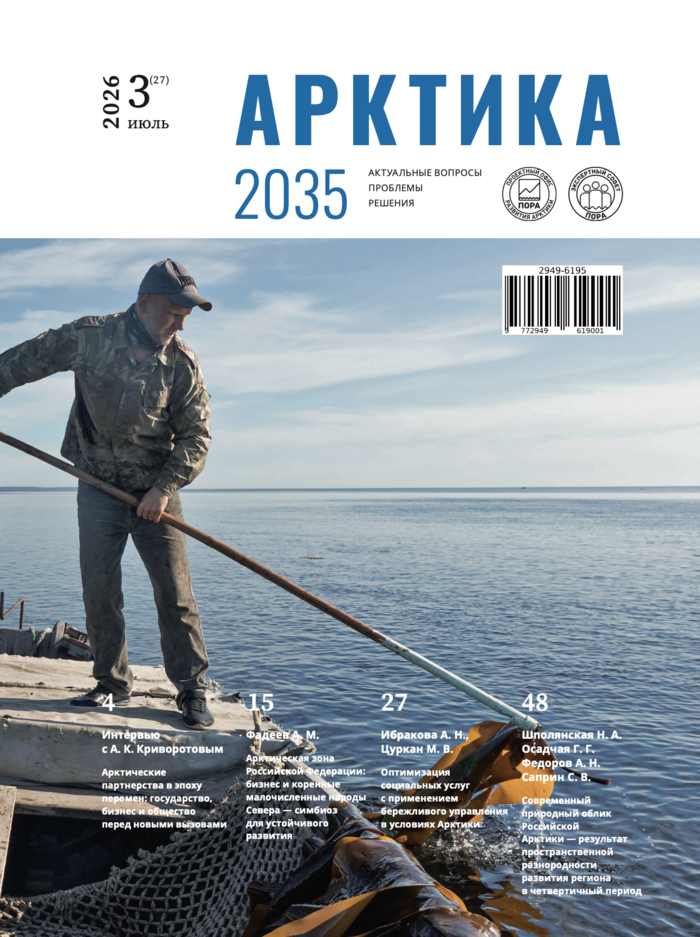
This article examines the prospects for extending social entrepreneurship status to enterprises operating in the field of secondary raw materials and waste management, with a view to stimulating the development of a circular economy in the Arctic zone of the Russian Federation. The objective of the study is to assess the prospects for extending social entrepreneurship status to eco-businesses in order to foster a circular economy in the Arctic zone of the Russian Federation. The research methodology is based on a combination of descriptive and structural analysis. The author concludes that, if successfully implemented, this initiative should become a catalyst for the waste and secondary resource management industry (secondary material resources, or SMR, as termed by a number of regulatory documents) in the region. It will mitigate and possibly eliminate the problem of the economic unprofitability of recycling in Arctic regions. By providing tax and other incentives to eco- enterprises, the state will enable them to develop a sustainable business model. This, in turn, will lead to a mass exit of enterprises in the industry from the «gray zone», the creation of new jobs, and the emergence of a class of local operators. The latter will become the grassroots link necessary for the implementation of larger logistics projects and new approaches to waste disposal, the use of SMR, and the processing of secondary raw materials.
The article examines the multidimensional effects of climate change on the Murmansk Region, a strategically significant territory within the Arctic Zone of the Russian Federation (AZRF), combining industrial, transport, and natural resource potential of the North. Intensifying climate dynamics — manifested in abnormal temperature increases, declining ice cover, and the progressive Atlanticization of Arctic seas — lead to complex transformations affecting environmental conditions, economic stability, and the social sphere. Due to the high concentration of infrastructure facilities, extractive industries, port complexes, and traditional economic systems of indigenous peoples, the region serves as a sensitive indicator of ongoing climatic processes.
The aim of the study is to identify the key consequences of climate change in the Murmansk Region and develop adaptation measures aimed at minimizing negative effects on its natural resource system and socio- economic development. The research methodology is based on content analysis of scientific literature, observational data from domestic and international authors, official statistics from Murmanskstat, and strategic planning documents.
The materials were systematized according to thematic categories: climate factors, their consequences for marine ecosystems and infrastructure, and socio-cultural aspects. Based on this analysis, a set of adaptation measures was developed.
The main findings indicate that climate change drives the redistribution of natural resources, alters hydrological regimes, and transforms biological communities — processes particularly critical for the region’s fishing industry. There is an observed increase in operating costs for enterprises in the energy and industrial sectors, growing pressure on transport infrastructure, higher accident rates involving engineering facilities, and disruptions to logistics chains. At the same time, new opportunities emerge for environmentally oriented industries, logistics hubs, and modernization of production systems.
The practical significance of the research lies in proposing adaptation measures that form a foundation for a comprehensive regional climate strategy integrating environmental, economic, and social components, thereby strengthening the Murmansk Region’s resilience to long-term climate challenges.
This analytical review demonstrates the potential for using climate projects as a tool of voluntary climate regulation in the field of waste management within the Arctic Zone of the Russian Federation (AZRF), in the context of the global and national climate agenda. The main objective of the study is to identify and substantiate promising directions for the implementation of climate projects that would simultaneously reduce greenhouse gas emissions and improve the efficiency of waste management, taking into account the specific natural-climatic and socio-economic conditions of the Arctic.
The methodological basis of the work includes an analysis of methodological documents from international and national climate project registries, existing approaches to waste management in Arctic states and in Russia, assessments of climate mitigation potential, as well as a systemic analysis of their interrelation with the conditions of this territory. The authors demonstrate that despite the high level of international attention to waste generation in sparsely populated and hard-to-reach areas, there is in fact a lack of projects adapted to the conditions of the AZRF that target the reduction of greenhouse gas emissions from industrial waste, including mining waste, oil-contaminated sites, and other facilities exerting negative environmental impacts. Based on an examination of methodologies presented in climate project registries, covering waste processing and resource efficiency, the use of mineral waste for carbon sequestration, etc.— the study substantiates the feasibility of forming a pool of priority climate technologies for the Arctic.
The practical significance of the work lies in establishing a foundation for the development of specialized climate projects in the AZRF, enabling companies to obtain both financial and reputational benefits.
This article examines the formation of environmental identity within the context of Arctic tourism on the Svalbard archipelago. The aim of this study is to identify the characteristics of environmental identity within the context of Arctic tourism on the Svalbard archipelago through a systematic examination of Russian and international discourse, including Norwegian discourse. The theoretical framework of the study is based on a postmodern paradigm, which views text as a projection of a person's external and internal worlds, expressed through a system of signs and symbols. A cognitive- semantic approach was employed, according to which the semantic meanings of linguistic units were identified through an analysis of their conceptual structure and contextual use. Linguistic tools allow us to identify environmental identity by identifying vocabulary and expressions that indicate an individual's awareness of their inextricable connection with nature, as well as their concern for its well-being. As a result of this research, the authors conclude that two distinct approaches to interaction with nature exist on the Svalbard archipelago. Russian tourists travel to Svalbard for direct contact with the powerful and respectful elements, forming their identity in connection with nature through overcoming difficulties and accepting its laws. Foreign tourists come to contemplate this «miracle» with like-minded people and/or families, forming their identity through its protection and responsible consumption. This study demonstrates the differences in the environmental identities of tourists from Russia and other countries through the lens of Arctic tourism.
COMPARATIVE ANALYSIS OF THE LEGAL FRAMEWORK AND FOREST MANAGEMENT INSTITUTIONS IN THE ARCTIC REGIONS OF RUSSIA AND FINLAND (THE CASE OF ARKHANGELSK REGION AND KAINUU REGION)
The article is devoted to a comparative analysis of the legal frameworks and institutional structures of forest management in the Arctic regions of Russia and Finland, using the Arkhangelsk Region and the Kainuu Region as case studies. The relevance of the study is determined by the rapid transformation of Arctic forest governance, where climate-related challenges and institutional shifts necessitate the development of new management models that balance economic development with environmental sustainability. The aim of the research is to compare the legal frameworks, institutional mechanisms, and environmental policy instruments, including certification systems and forest-based climate projects, used in the forestry sectors of these Arctic regions. The methodological basis of the study includes comparative legal and institutional analysis, as well as a world-political perspective applied to legislation of the Russian Federation and Finland, regional regulatory documents, and data from relevant institutions. The findings indicate that forest governance in Russia is characterized by a centralized hierarchical system with extensive regulatory requirements, while the Finnish model is decentralized, outcome-oriented, and based on cooperation with private forest owners. The implementation of climate-related innovations is at an early stage in both regions.
The practical significance of the study lies in the fact that its results and recommendations can be used by governmental authorities and local municipalities when developing cross-border cooperation programs, harmonizing environmental standards, and improving verification methodologies for forest-based climate projects in the Arctic.
Arctic museums as objects of research were first systematically examined within the framework of the project «Study, Preservation, and Popularization of the Historical and Cultural Heritage of the Arctic» in 2021 From 2021 to 2023, project experts analyzed the spatial distribution and history of museum development in the Arctic Zone of the Russian Federation (AZRF), assessed the scale and thematic composition of museum collections, and identified distinctive features of exhibition practices and visitor engagement. During this period, the Section of Arctic Museums was established within the Union of Museums of Russia, bringing together museums not only by topic but also by territorial affiliation. The main objective of this paper is to evaluate the outcomes of interregional cooperation among Arctic museums and to identify key challenges and promising directions for strengthening a unified sociocultural space in the AZRF. The empirical basis of the research includes the examination of the updated exhibition of the Murmansk Regional Museum following its reconstruction; expert discussions on issues related to reconstruction of museum buildings in Arctic environments, creation of contemporary exhibitions, use of multimedia technologies, and visitor engagement strategies; surveys of directors of Arctic museums; as well as quantitative assessment of certain operational indicators. The methodological approach combines systematic analysis of outcomes of interregional projects from 2021 to 2025, synthesis of specific project cases within a broader understanding of the sociocultural and humanitarian potential of the Arctic, and the application of modeling techniques for outlining the future cultural framework of the AZRF. Among the most significant findings are the synergistic effects generated through project activities and the expansion of partnership networks for scientific, professional, administrative, and informational cooperation facilitated by the Section of Arctic Museums. The practical relevance of the research lies in demonstrating the results of collaborative initiatives implemented by Arctic museums. Strengthening interregional professional interactions among museums contributes directly to the consolidation of a unified sociocultural space within the Arctic Zone of the Russian Federation.