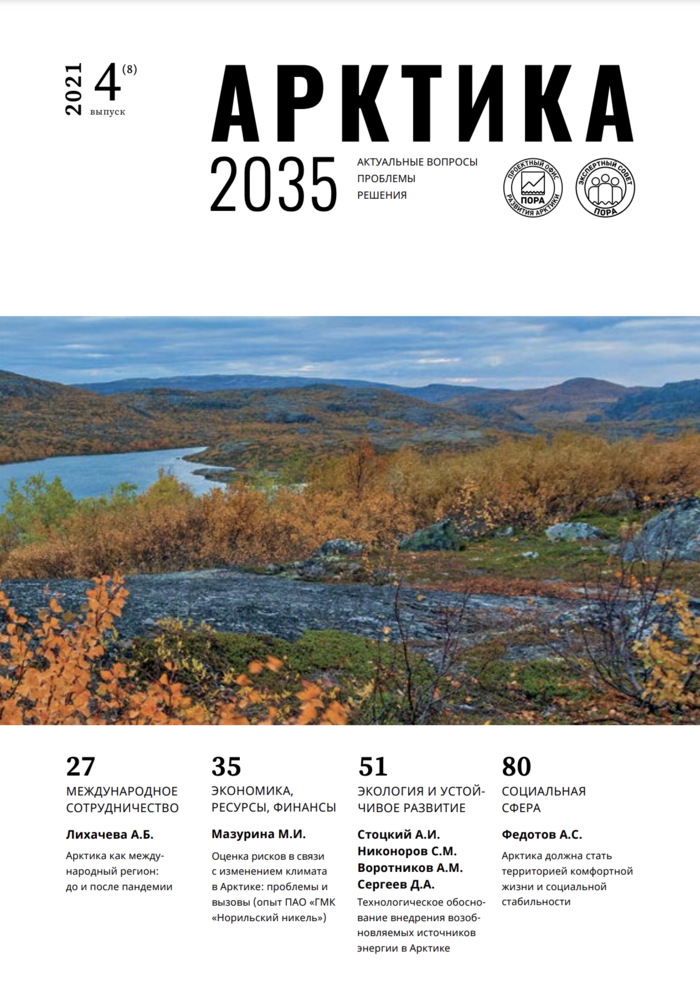
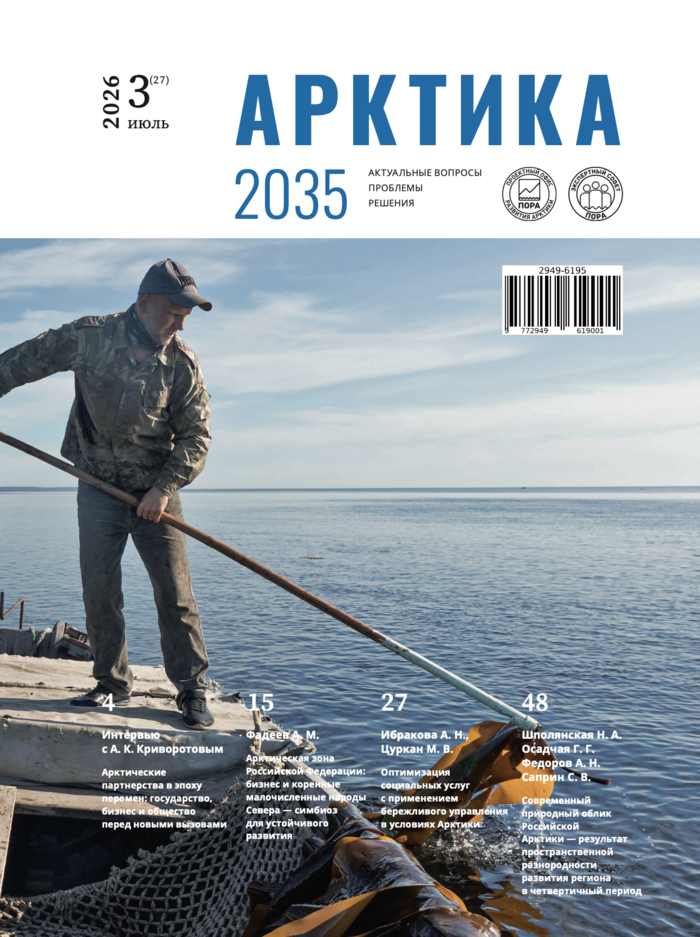
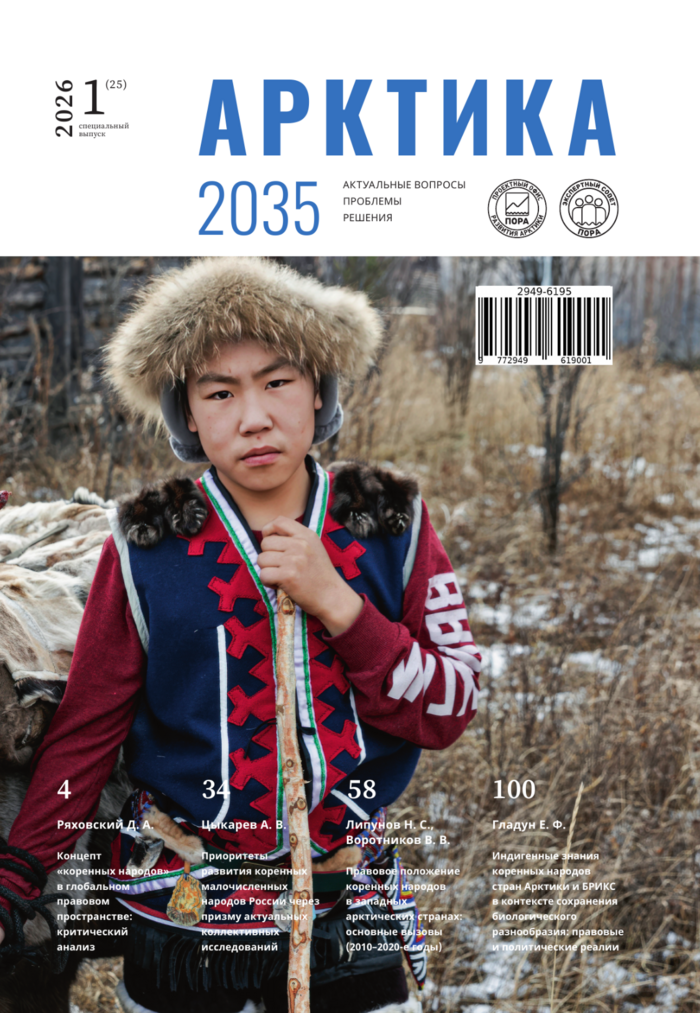
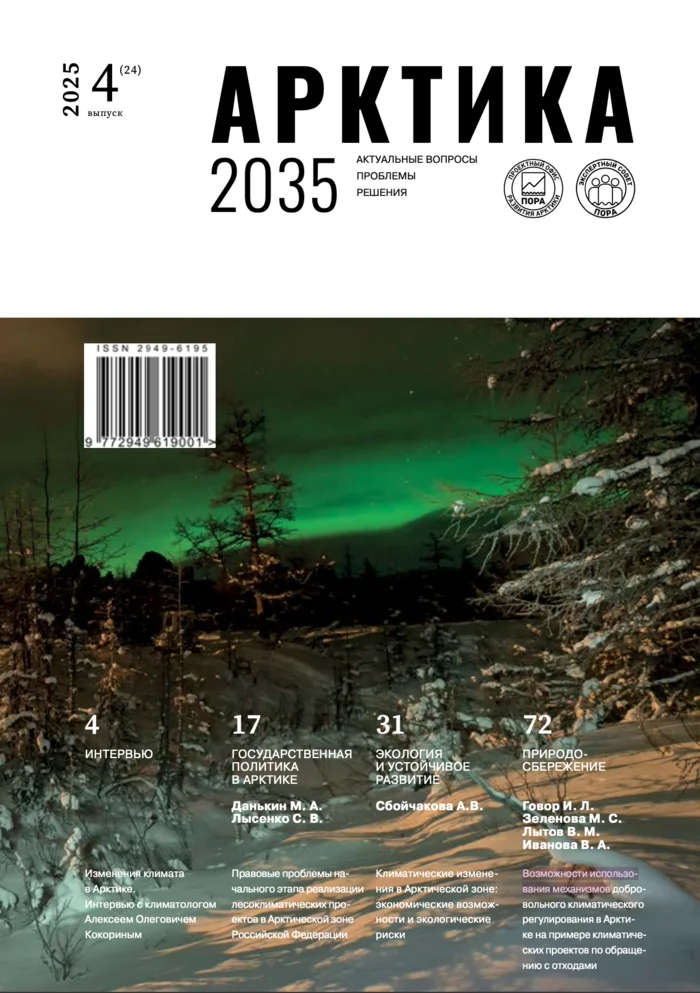
This issue publishes articles dedicated to current directions and challenges in the development of the Arctic Zone of the Russian Federation. These articles were prepared by the authors based on reports presented at the roundtable «Current Directions for the Development of the Russian Arctic as a Geostrategic Region,» which took place on July 15, 2021, at the RANEPA (Russian Presidential Academy of National Economy and Public Administration) with the informational and organizational support of the Project Office for Arctic Development (PORA).
The Arctic zone is a priority geostrategic territory of the Russian Federation, the socio-economic conditions within which require the allocation of individual directions, priorities, goals and objectives of the socio-economic development of the territory. The land territories of the Arctic zone of the Russian Federation include the territories of 13 municipalities of the Republic of Sakha (Yakutia): Abyisky ulus (district), Allaikhovsky ulus (district), Anabar national (Dolgan-Evenk) ulus (district), Bulunsky ulus (district), Verkhnekolymsky ulus (district), Verkhoyansk district, Zhigansky national Evenk district, Momsky district, Nizhnekolymsky district, Oleneksky Evenk national district, Srednekolym (district), Ust-Yansky ulus (district), Eveno-Bytantaysky national ulus (district). The Arctic zone of the Republic of Sakha (Yakutia) is distinguished by extreme natural and climatic conditions, low population density, high resource intensity, the focal nature of industrial and economic development and the dependence of life on the northern delivery. The above factors determine the need for constant presence and attention from the state.
Low-carbon economic development is increasingly high on the international agenda. Moving from the Millennium Development Goals to the Sustainable Development Goals with a particular focus on the climate dimension, the adoption of the Paris Climate Agreement, efforts to introduce a cross-border carbon tax by the EU countries and a number of other initiatives aimed at improving environmental conditions in different regions of the world, prompting many countries to adopt measures at the national level to reduce greenhouse gas emissions. This article reviews the successful experience of implementing climate policy by the European Union and Russia’s current plans to decarbonize its economy.
World-class research and educational center “Russian Arctic: new materials, technologies and research methods” in solving the problems of the development of the Arctic zone of the Russian Federation: problems and prospects
The exploration and development of the Arctic has always been strategically important for Russia and the USSR. The organization of great Arctic expeditions, the creation of the USSR Glavsevmorput, the work of the Ministry of Development of the Russian Federation of the Far East and the Arctic on the implementation of the Fundamentals of State Policy and Development Strategy of the AZRF testify to this. Scientific and educational centers are a unique new tool for the spatial development of the Russian Federation. When applied in the Russian Arctic, they allow to obtain a synergistic effect of the socio-economic and political leadership. An interregional world-class REC “Russian Arctic: new materials, technologies and research methods” with center in Arkhangelsk was created in 2020. In July 2021, the interregional REC of the third wave “North is a Territory of Sustainable Development” with a center in Yakutsk and REC “Yenisei Siberia” with a center in Krasnoyarsk, among others, became the winners of the all-Russian selection and will be able to apply for grants from the federal budget. The West Siberian REC, which began work in 2019, also claims to be on the Arctic agenda.
The Arctic region has in many ways become one of the least affected by the pandemic as such: the exceptions were the actual stop of international, primarily Chinese tourism in the Arctic and certain difficulties in countering the pandemic in the remote regions of the Far North. However, the changes in the international system and the nature of relations between its key participants that have occurred during the pandemic are capable of (and are already having) a significant impact on the Arctic region, the relations of the Arctic powers with each other and with non-Arctic countries. The most interesting shift concerns the fundamentally increased tolerance of the Arctic countries to the recognition of the climate threat as an objective threat and, at the same time, not having a specific carrier, an “enemy”. In a sense, this is also one of the lessons of the pandemic: before the events of 2020, climate challenges remained in many ways a unique similar “subjectless” phenomenon for international security. In this article, we document the key qualitative shifts in the Arctic agenda over the past two years and suggest the main directions for international dialogue that Russia could initiate during its chairmanship of the Arctic Council, which began in May 2021.
Climate change is one of the major aspects of global sustainable development. Companies are actively involved in forming climate change adaptation plans. The fastest acceleration of average annual temperature takes place on the shore of Arctic Ocean, particularly on Taimyr Peninsular. Nornickel pays major attention to management of climate change physical risks. The Company undertook major steps towards mitigation of physical risks. However, there are some key challenges that require systemic approach from scientific community, government bodies at different levels and corporate sector that will be covered in the article.
The study examines a range of issues devoted to the effective use of the opportunities of St. Petersburg in the development of Arctic projects. A comprehensive analysis of the state of the industrial complex of St. Petersburg is given and an objective assessment of the prospects for St. Petersburg’s participation in projects for the development of the Arctic is given. Much attention was paid to the formation of organizational and economic mechanisms for the use of industrial enterprises in the implementation of oil and gas and industrial projects on the territory of new producing regions in the Arctic.
According to the Intergovernmental Panel on Climate Change, since the 1970s, global warming has been observed, which manifests itself in an almost linear increase in temperature and is associated with an increase in the concentration of greenhouse gases in the atmosphere due to an increase in their anthropogenic emissions. In these conditions, ensuring sustainable socio-economic development of the Russian Federation is associated with the need to gradually change the structure of the economy by diversifying it in accordance with growing climate challenges, which will also contribute to the achievement of global goals enshrined in international agreements on climate. This will create the basis for the protection of domestic exporters and lay the prerequisites for the technological transformation of the economy. In turn, the transition to the trajectory of the Intensive low-carbon development scenario will allow achieving carbon neutrality in the second half of the 21st century closer to its end. Under any scenarios, you will have to switch to renewable energy sources. In the baseline scenario – from 1 % to 2.5 %, and in the intensive scenario – up to 4 % and more. The article presents an analysis of various types of renewable energy sources for their possible implementation in the Russian Arctic. The dynamics of the development of renewable energy sources is also presented.
The fishing industry is one of the traditional sectors of the economy, especially important for the Arctic part of the planet. In our time, attention is increasing to the development of the fishing industry, both at the state and international levels. The Arctic is one of the most environmentally vulnerable regions in the world. Active industrial development, such as offshore oil and gas production, carries risks for the state of fish populations and quality. Climate and environmental changes require additional support measures. There is a need to combat illegal, unreported and unregulated (IUU) fishing. There are various solutions to prevent the loss of fish populations. One of them is artificial fish farming, aquaculture The volume of aquaculture production is increasing due to various types of regional support for fish farming enterprises.
In our study, from a theoretical and practical point of view, we analyzed the directions of green finance in various elements of the green economy. In Russia, by the beginning of 2015, the portfolio
of investment projects in the field of renewable energy sources amounted to more than 100 billion rubles. Until 2025, the Ministry of Natural Resources intends to attract about 3.5 trillion. rubles for
the development of renewable energy sources. In January 2019, the national project “Ecology” was approved in Russia, where 19.9 % is government funding, the rest is a great potential for the development of green financing for all 11 Federal Projects, especially BAT. The article shows the experience of the Green Investment Group (UK), which raised 2.9 billion pounds sterling in 2020 to finance 250 green energy projects. The paper presents successful projects for the use of green finance in Russia.
Yakutia, which has huge natural resources, transport corridors and big potential for the development of human capital, in many respects is becoming one of the key regions of the world. Significant positive changes in the Arctic are associated with industrial development. But at the same time, an important task is to find a balance in the question of “economy or ecology”. And first of all, this issue should be considered through the prism of preserving the living environment and economic management of the indigenous peoples of the North. The state policy of the Russian Federation and the Arctic regions of Russia fully responds to modern challenges and is aimed at sustainable development of the Arctic, an example of which is the development of the Arctic districts of the Republic of Sakha (Yakutia).
Scientific results of the first year of implementation of the project “Institutional engineering of single-industry towns in the Arctic zone —modernization and sustainable development” by the Russian Science Foundation
The Russian Science Foundation project at the Republic of Karelia “Institutional engineering of monocities of the Arctic zone – modernization and sustainable development “ is the winner of the in 2021 research direction “Conducting fundamental scientific research and exploratory research by individual scientific groups.”
The aim of the project is to develop an integrated approach to single-industry towns in the Russian Arctic within the framework of modernization and sustainability concepts. The list of single-industry towns, which is being studied within the framework of the RSF project, was formed on the basis of the Government Order of the Russian Federation on July 29, 2014 No. 1398-p. The geography of the project covers 18 monocities of the Russian Arctic.
The main scientific results of 1st year project include desk research, pilot field research in monotowns of Murmansk region and Republic of Karelia, project data visualization in Microsoft Power BI.
Family policy is one of the priority areas of state policy at the moment. A large number of measures have already been taken to support families, and they are already showing their first results. But does the state have enough resources to independently implement such large-scale projects? This article examines the interaction of the state and business in order to implement family policy at a higher level with the use of more resources and mechanisms. Special attention is paid in the article to the interaction of the state and business in the implementation of family policy in the Arctic regions of Russia (Murmansk Region and the Republic of Sakha (Yakutia)).
Despite the extensive field research decisions of the Murmansk region, little is known about the impact of corporate policies on people leaving the region. The general picture that emerges from literature is as follows: young people move to study in large southern cities and stay there; retirees are also looking to move south. As a solution to the first part of the problem of widespread regional universities. The mining industry is the main industry in the region. Analyzes the research of some residents of mining cities through qualitative interviews with 22 residents of the cities of Apatity and Kirovsk, as well as through two focus groups. Interviews were taken in 2013, when a reorganization of management and restructuring began at the mining company Apatit, which led to a reduction in benefits for employees. Focus groups were held in 2018 when the reorganization was completed. The analysis of this material includes explanations that show that people do not wait for retirement, which starts five years earlier in the southern regions of the country, in order to move south. They are at their most productive age – 30-40 years old – leaving the cities of Apatity and Kirovsk in order to have time to build their lives in the south. A largely untapped source of oral histories for residents of Arctic cities, where well-being depends on mining company policies, makes this article a contribution to further research on similar topics.
Accelerating global warming enhances interest of leading world powers to development of the Arctic. This polar region has great amount of natural resources deposits, contains abundant biological resources, enjoys significant logistics potential, plays important role in geopolitics. The task of the Arctic development leads to the increased requirements to managerial competencies of officials, who are responsible for territory development policy in harsh climatic and ecological environment. Thus there is a need to develop educational programs for public and private sector employees to form competency profile for designing and implementing modern managerial tools for complex development of the north territories. These educational programs should provide professional mobility of specialists and managers, create flexible career paths to ensure solution of various strategic tasks. There is experience of designing of such programs in Russia, in Republic of Sakha (Yakutia). This experience can be used by other educational institutions from other regions for development of their own educational products.