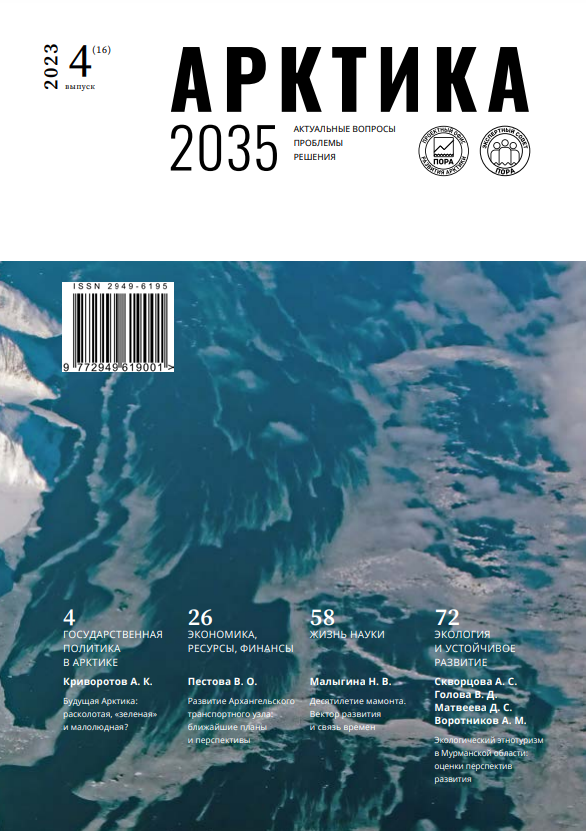
In this final issue of 2023 you will find both a serious geopolitical forecast for the development of the Arctic in the coming years and a practically detective-like story of the search for mammoth remains preserved across the vast northern expanses.
The ongoing split of the global Arctic, with Western countries freezing cooperation with Russia, had been maturing over time, as the increasing number of Arctic stakeholders pursued different interests and the world economy and politics entered a deep transformation. Over the past few years, these differences sparked ideologically laden discussions on Arctic futures: the role of humans, governance and target images of the region. The U.S. has taken advantage of the international tensions to start establishing its leadership role in the Western half of the Arctic, promoting a narrow agenda of confronting Russia (with a special role for NATO involvement), blocking China, decreasing hydrocarbon activities and imposing major limitations on economic activities at large. Climatic and environmental slogans, as well as vague ESG principles, will be used to apply pressure on other nations, notably on Russia. Such approaches, which largely reflect the specific American Arctic agenda, are likely to get support from Canada, Sweden, and the EU. Meanwhile, this hard line is not just incapable to meet the global Arctic challenges (including the issues of environment and Indigenous interests, which are highly appreciated in the West), but may equally damage the economic development of Iceland, Greenland, and Norway. Russia on its part sees no realistic opportunities for cooperation with Western countries and is ready to provide access to the Arctic for constructive non-regional states. In the next 15–20 years the Arctic is therefore likely to stay ideologically divided, open for outside parties, exposed to hard, environmentally motivated international pressure, and more militarized. Its global importance will be diminishing, as the global focus progressively squeezes towards the key theater if U.S. — China confrontation, the Indo-Pacific.
In legal terms, the BRICS as a group is not an international organization, since it is not endowed with legal capacity, functions without constituent acts, does not have a formalized organizational structure, and does not make legally binding decisions. BRICS can be defined as an informal interstate association, however, it is precisely this format of interaction between countries that gives them the necessary flexibility in the use of legal mechanisms, and also allows them to develop dynamically and identify new vectors of cooperation. One of these vectors has recently become cooperation between the BRICS countries in the Arctic. Today, the attention of many states is focused on the Arctic, which is rapidly becoming a point of geopolitical and economic interests. However, the difficult political and economic global conditions is discouraging interaction between the Arctic countries. These circumstances, at the same time, increased interest in the Arctic on the part of the BRICS countries and intensified the implementation of their joint projects. The Russian Federation, the only one of the BRICS countries, is an Arctic state and sets its own goals for the development of the Arctic region. India and China have recently become the most active «non-Arctic» participants in the Arctic projects, implementing mainly “scientific diplomacy and investing in some economic activities. Brazil and South Africa have not yet taken any action to develop cooperation in the Arctic region. Considering the emerging trend, it is advisable for the BRICS countries to consolidate their legal status in international documents and include specific joint events in the agenda for the coming years, as well as synchronize the goals and objectives of Arctic cooperation.
The development of the Arctic zone of the Russian Federation is a national priority of Russia’s domestic policy, which includes not only the development of logistics and infrastructure projects, but also the socio-economic development of the Arctic region. Social policy plays a key role in the future development of the region and its long-term planning, because social policy determines the quality of life of the population and significantly affects the socio-demographic indicators of the region.
The Government of the Russian Federation pays serious attention to the development of the North — a number of conceptual documents have been adopted, and a lot of work has been done to create a legislative foundation for the sustainable development of the Arctic. There is a clear understanding in Russian senior political circles that the future of the country is inextricably linked with the fate of the Arctic regions. The importance of the North will only increase in the coming decades, since here is the main base of the state’s energy resources and the national transport route of Russia — the Northern Sea Route, the only ocean communication that passes through the territorial waters of the Russian Federation throughout its entire length. In this regard, the role of seaports located along the Arctic coast is significantly increasing. The seaport of Arkhangelsk is no exception. The article discusses the opportunities opening up for the Arkhangelsk region in the field of maritime logistics. It is shown that their implementation will be facilitated by the development plan of the Northern Sea Route and the comprehensive plan for the development of the Arkhangelsk transport hub.
RELIABLE AND EFFICIENT NAVIGATION OF VESSELS OPERATING ON THE NORTHERN SEA ROUTE: ASPECTS OF SHIP REPAIR FACILITIES’ DEVELOPMENT IN THE PORTS OF THE WESTERN ARCTIC
The article highlights the aspects of ensuring sustainable and safe navigation along the Northern Sea Route and the Western Arctic through the prism maintaining technical conditions of the merchant fleet operating in the Arctic. Data is provided on the composition of vessels attached to the Arkhangelsk transport hub. The specifics of ship repair enterprises in the Arkhangelsk region and their ship-lifting capacities are highlighted. The problem of the current shortage of ship repair services and maintenance for the Arctic vessels is articulated. The trend of a projected increase in this deficit is emphasised. In conclusion, a solution to the problem of shortage of ship repair capacity in the Western Arctic is proposed.
THE MAIN DIRECTIONS OF SUSTAINABLE FUNCTIONING AND PRIORITIES FOR THE DEVELOPMENT OF THE NORTHERN SEA ROUTE AS A COMPETITIVE NATIONAL TRANSPORT COMMUNICATION
The article considers topical issues related to the development of transport potential of the Northern Sea Route, in the context of increasing the intensity of shipping and the growth of freight transport. The article presents an analytical study of the problems of attractiveness of NSR in the context of fierce competition in the marine transport services market. An analysis of the state and trends in the development of cargo transportation according to the NSR was carried out taking into account forecast estimates. The most important factors of the functioning of the Northern Sea Route have been studied, taking into account regional specific features. Modern tendencies of work of objects of port infrastructure are considered. On the basis of the study the author’s view on the priority directions of development of the transport and infrastructure complex of the Northern Sea Route, for which it is necessary: improvement of the organizational structure of management, Implementation of safety measures for navigation, establishment and development of coastal infrastructure, modernization and construction of multifunctional ports, availability of modern icebreaking fleet, operation of monitoring systems.
The study provides the development of a mechanism for managing investment risks in the development of oil and gas fields in the Arctic. Such projects are accompanied by a high level of uncertainty and require a thorough analysis of possible risks. At the same time, the study was based on the analysis of various regulatory documents, which made it possible to consider various nuances of evaluating large Arctic projects. An integrated approach was used, which allows considering the risks in the financial and economic model of the investment project and at the same time avoiding the possibility of double counting of risks.
The reasons for the extinction of mammoths are currently unknown. This article presents an analytical review of some of the results of ten years of research on fossil samples of megafauna of its period by an international scientific expedition to Taimyr, implemented within the framework of the Mammoth program.
Nowadays, the Arctic zone of the Russian Federation has become one of the main geostrategic territories of Russia. This article addresses such an important issue as reliable energy supply, which is possible through the use of new environmentally friendly energy sources. The Arctic zone of the Russian Federation has great potential for the use of renewable energy sources (RES) and has the necessary prerequisites for their accelerated development. To solve it, the article proposes to intensify the interaction between the state and business through the development of public-private partnership.
The authors set a goal to conduct a situational analysis of the development of ecological ethnotourism in the Arctic zone of the Russian Federation, as well as its implementation in the economic activities of such indigenous people of the North as the Sami. The key research method was our own survey in order to identify the degree of awareness of the population about the activities of indigenous peoples of the North, as well as to identify the population’s attitude towards ecological ethnotourism. The respondents were 147 people aged 16 years and over. The authors conclude that the population is not sufficiently aware of ecological ethnotourism and the activities of indigenous minorities. However, a high degree of interest among respondents in this non-standard type of tourism was revealed. Based on the survey results, the authors developed an ecological ethnotour in the Murmansk region, the implementation of which will be aimed at promoting the development of tourism, supporting the Sami, and also preventing the deterioration of the environmental situation in the Murmansk region.