This issue contains many «visionary» articles that, in one way or another, outline the contours of a not-so-distant future. For instance, our authors have done very serious work on the topic of artificial intelligence.
The article reveals the methodology and methods of the Polar Index project. The goal of the Polar Index project is to increase general interest in the topic of sustainable development — the concept of how companies or territories can develop harmoniously and balanced, thinking about the future and investing in it. Ratings encourage companies to more actively implement the principles of sustainable development in their activities, and territories — to build a policy for the maximum achievement of sustainable development goals. In addition, the publication of the Polar Index ratings encourages the openness of companies and territories, their readiness for dialogue with society and public presentation of their work. This ultimately benefits everyone who lives and works in the regions of the North — government agencies, businesses and, most importantly, residents of the Arctic. The author’s approaches to the development of a sustainable development model, to the development of the concept and principles of sustainable development are also revealed.
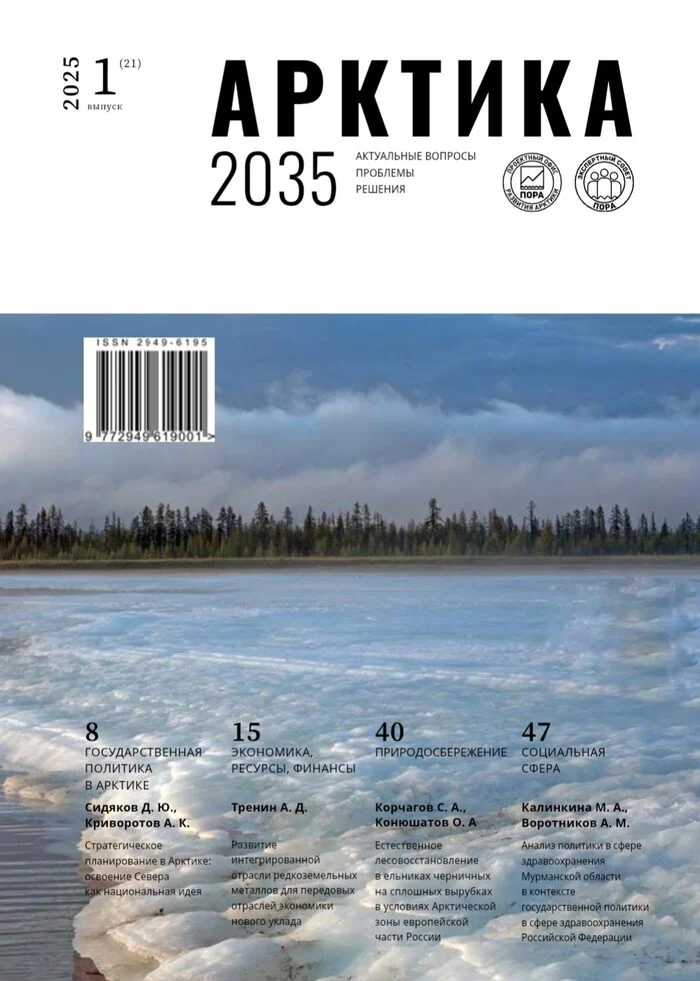
The article addresses the ongoing international shifts in the Arctic under among other U.S. President D. Trump, plus suggests some ideas on the upcoming adjustment of the Russian Arctic strategy as initiated by the nation’s political leadership in late 2024–early 2025. This work should reflect the increased volatility of global developments, rely on the fundamental values, mind the recent procedural changes (as of 2024, strategic planning in Russia is based on national development goals), and ensure coherence of the numerous valid documents adopted by various levels of government. The authors support the proposal to elevate the Russian Arctic development to the level of a distinct national project, given its comprehensive nature and paramount nationwide importance.
The article examines the current affairs in the rare earth metals (REM) industry of Russia, including the key events which led to the dramatic fall of the country’s share of the global REM production. The author gives his view on the ways to develop the REM industry as one of the sinequanon elements of the new economic paradigm. Special attention is paid to the rare earth metals projects in the Arctic, which contains more than 70 % of REM resources of Russia. The largest REM deposits are SWOT-analysed, and the models of their effective launch are also demonstrated. China’s role in the global REM industry is described, as well as its state support measures which secured the country’s actual monopoly in the global REM production. In conclusion, the author gives his assessment of the need to build a vertically and horizontally integrated rare earth metals industry in Russia using the complex measures and strong state support.
The article describes the current state of the Northern Sea Route as a transport and logistics corridor of the Arctic, identifies the main advantages of this route, as well as trends and prospects for its devel-opment. The article also examines aspects of the integration of the Northern Sea Route with other transport routes and its impact on the regional economy, assesses the role of modern technologies in increasing its efficiency. Weaknesses of the Northern Sea Route are identified, and recommendations for overcoming them are given. Special attention is paid to the analysis of the state and prospects for the development of the infrastructure of this transport corridor in order to form a sustainable and high-quality transport system in the Arctic region of Russia.
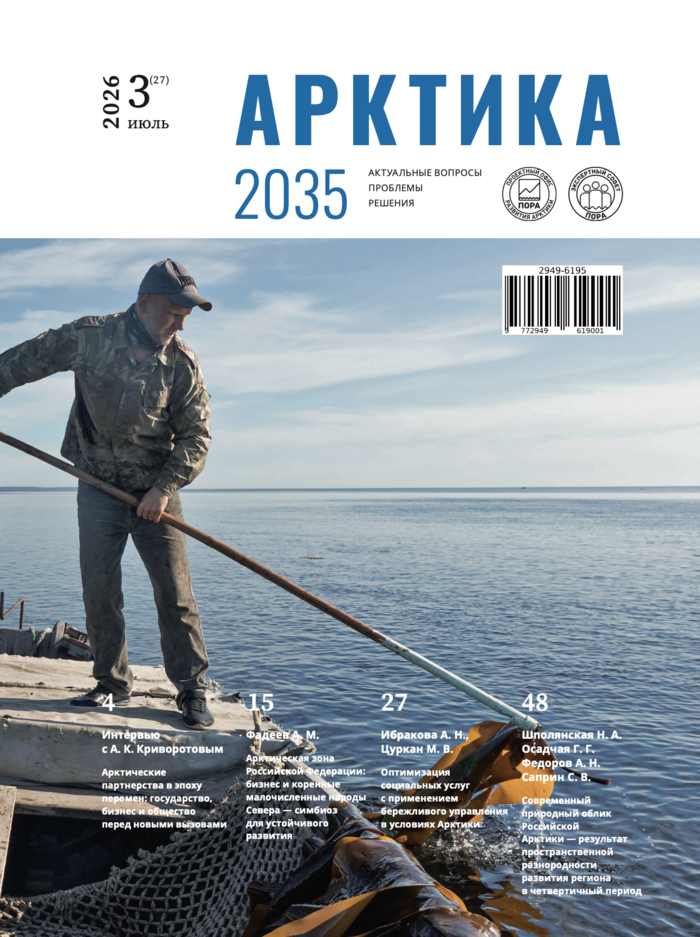
The article describes the history of Greenland, the superpowers’ policies towards it, as well as the main challenges and opportunities in the modern Arctic. Some risks of world-class Arctic projects, their consequences and mitigation measures are described. The main Russian projects in the Arctic, their features, risks and risk management are presented. The main directions and prospects for Russia’s development in the Arctic are considered.
Rational nature management in the Arctic zone should be based on the introduction of modern technologies and the use of technological means in timber harvesting, allowing to minimize the negative impact on the state of ecosystems with profitability from forest use. One of the possible ways to promote the restoration of areas damaged during timber harvesting is timely and high-quality reforestation of felled areas with economically valuable species. The Federal Budgetary Institution «Northern Forestry Research Institute» (FBU «Northern Forestry Research Institute») conducts active scientific research to improve the system of forest management measures in the forests of the Arctic zone of the European part of the Russian Federation. This publication has been prepared based on the results of work carried out within the framework of the state assignment of the FBU «Northern Forestry Research Institute» to conduct applied scientific research on the topic «Increasing the efficiency of forest use in the Arctic zone of the European part of the Russian Federation through optimization of felling during timber harvesting» (Registration number of the topic — 123032700030-9). Based on the research, the possibility of successful natural restoration of felling areas with economically valuable tree species after clear and clear sanitary felling of a significant area in bilberry spruce forests using multi-operational logging equipment due to the preservation of spruce undergrowth of the preliminary generation and the appearance of a new generation of forest after felling has been proven.
Strategic development of the Arctic zone of the Russian Federation is a national development goal until 2035. Insufficient development of healthcare and its poor accessibility in remote areas are one of the key problems of the Russian Arctic. The Arctic region is characterized by extreme natural and climatic conditions, high concentration of industry and the economy as a whole, and low population density. The article examines the problems and prospects for the development of healthcare in the Murmansk region.
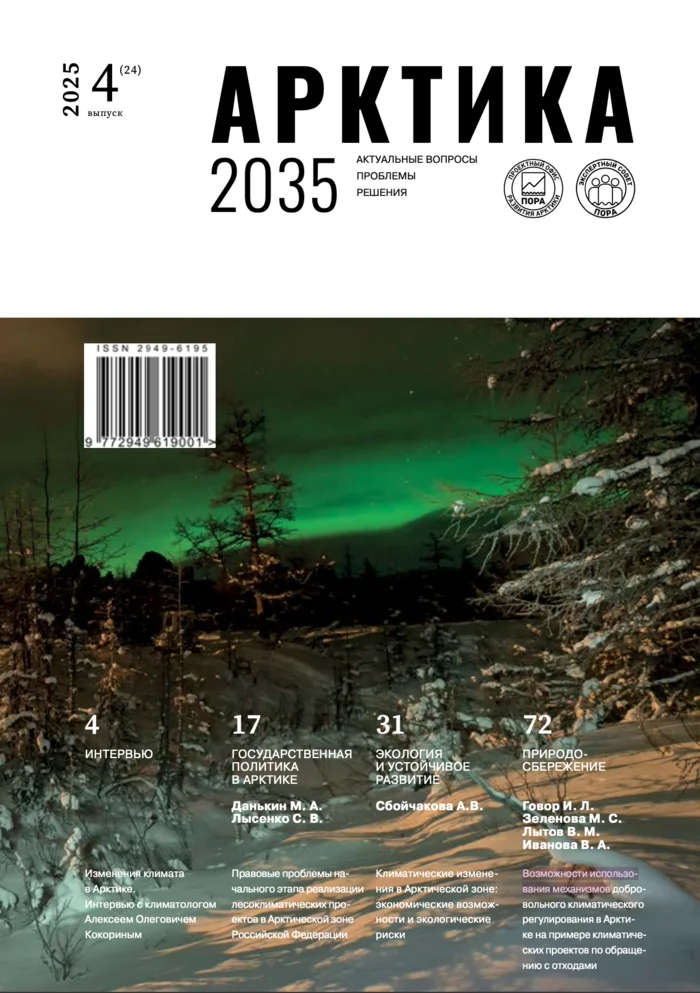
In modern conditions, the priority of the development of the socio-economic system is eco-development, which implies achieving harmony between society and nature in the context of the formation of a new quality of economic growth, which will ensure an increase in the standard and quality of life of the population. Achieving target benchmarks directly depends on the environmental situation, so the implementation of environmental monitoring is an integral and mandatory condition. The article presents the results of the analysis of the environmental situation in the Arctic regions of Russia using an assessment of the quality of the environment. Identification of trends and patterns of eco-development of the regions of the Russian Arctic will help in determining the priorities of socio-ecological-economic development, the formation of a new regional policy that takes into account the principles of greening. Despite the fact that the authorities are taking measures to ensure environmental safety and environmental protection, a high level of environmental tension is noted. The comparative analysis conducted on the basis of data on the implementation of regional projects within the framework of the national project «Ecology» allows us to assert that in order to achieve environmental well-being, it is necessary to create a healthy and safe ecological environment for residents of the Arctic regions of the Russian Federation based on the principles of greening, the formation of policies in the field of ensuring environmental safety, and the conduct of more effective environmental activities.
The article is devoted to analyzing the key role of the Arctic Zone of the Russian Federation (AZRF) in ensuring the socio-economic development and security of the country. Unmanned Aerial Systems (UAS) serve as an important tool for monitoring forest fires, aerial surveying, cargo delivery, and infrastructure patrolling in the Arctic. However, their application requires adaptation to harsh climatic conditions and addressing legal and technical challenges, such as ensuring communication beyond line-of-sight and utilizing frost-resistant technologies. The development of UAS with enhanced characteristics and specialized equipment opens new opportunities for the sustainable development and protection of Arctic territories.
With the ability to analyze huge amounts of data in real time, AI enables timely detection of potential threats and effective measures to neutralize them. The purpose of this study is to identify the key benefits and opportunities for implementing AI in disaster response processes. The article examines modern approaches and technologies, practical examples of using AI, and identifies the main problems and prospects for further development. This analysis allows us to present a systemic view of AI-based response optimization and justify the need for its integration into crisis management systems.
The article analyzes innovative models of public-private partnerships (PPP) using artificial intelligence (AI) technologies for sustainable development of the Arctic. The article considers key aspects of AI application in ice forecasting, environmental monitoring, and optimization of mining processes. Particular attention is paid to successful cases of AI implementation in the Arctic, such as the Smart Drilling Rig, Machine Vision at Kola MMC, and Botkin.AI platform projects. The article analyzes vacancies and competencies in demand in the field of AI, as well as the role of government support in technology development. The article emphasizes the need for a comprehensive approach to integrating AI into PPP models to ensure sustainable development of the Arctic, taking into account economic, environmental, and social aspects.