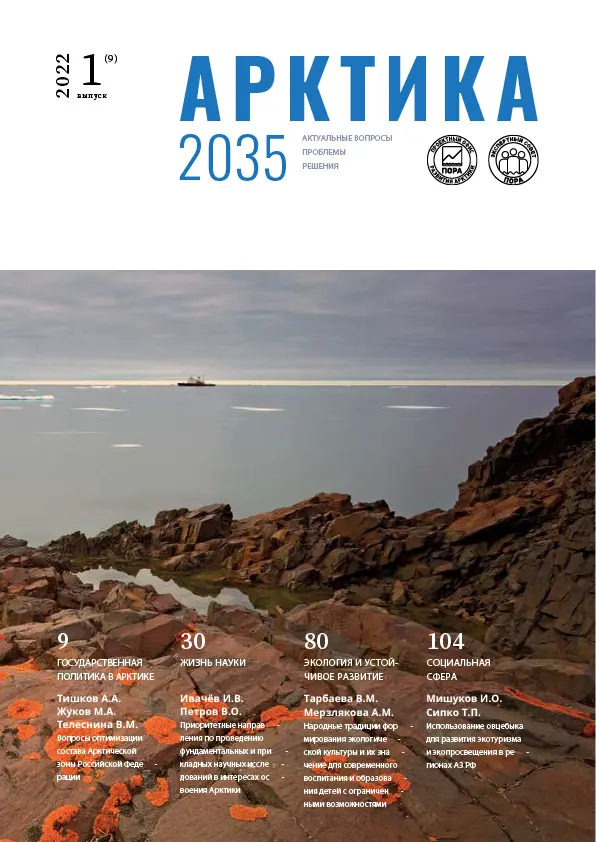
This issue is dedicated to education and environmental awareness in the Arctic. The need to update knowledge and acquire new competencies is more pressing than ever. It is precisely now, during the period of «sanctions wars,» that education is becoming an effective tool for overcoming their consequences. Moreover, the fragile and vulnerable nature of the Arctic demands that this education be eco-oriented, starting from a very young age.
The article deals with problematic of the modern development trends and business transformation in accordance with ESG concept, realization of such concept in projects of the Arctic region and education of specialists to ensure sustainable development of business in the ESG concept.
When deciding on the Russian Federation Arctic zone (AZRF) composition, the use of the conclusion of Institute of Arctic and Antarctic was declared, but in reality, the criteria of this institute were not applied to the territories of several regions, and on the ground the issue of the unfairness of this situation began to be discussed. The correspondence to criteria of AZRF is considered for several municipal districts of Karelia and Komi republics, Magadan Region and Kamchatka Krai.
The current practice of territorial environmental regulation in the legislation on Specially Protected Natural Area (SPNA) is based, unfortunately, on the predominant use of mechanisms of prohibitions and delimitations. The regulation of economic activity is not provided for in this legislation at all. The Town Planning Code and the Land Code only declare environmental goals. Meanwhile, the reserve of sustainability of the natural and social environment in the Arctic is practically absent. And yet there is an opportunity to combine subsoil use with traditional nature management, preservation of natural environment, ecological tourism and recreation in a nonconflict way. The proposed solution: special requirements for types of economic activity. These requirements should be enshrined in the territorial planning documents of the subjects of the Russian Federation or municipalities. It is possible to fix the requirements on the basis of the mechanism of defining and existence of zones with special conditions of use of territories. This is how management regimes of any level of flexibility can be established outside the system of specially protected natural areas or territories of traditional use of natural resources (TTNRU).
Modern approaches in architecture have made it possible to form universal tools for designing public spaces in Russian cities and settlements, but they do not allow projects to be fully implemented in the Arctic. The support measures created by the state are designed to form qualitatively new competencies in the training of architects working in the cities of the Arctic belt of Russia. This article examines the problem of “northern urbanism” and suggests methods for solving the problems of designing public spaces with the involvement of young architects, eminent specialists and the scientific community of Russian universities.
PRIORITY AREAS OF SCIENTIFIC AND TECHNOLOGICAL DEVELOPMENT FOR CONDUCTING FUNDAMENTAL AND APPLIED SCIENTIFIC RESEARCH IN THE INTERESTS OF THE DEVELOPMENT OF THE ARCTIC. SCIENTIFIC RESPONSE TO CLIMATE CHALLENGES
The article discusses basic and applied scientific research in the Arctic zone of the Russian Federation, including the background (how, when and by whom the previous International Polar Years were held). In particular, it looks at subsoil use, the use of coastal waters of the seas and oceans, opportunities for carbon storage, the ecological development of industry, the economic importance of the region through the Northern Sea Route, and the possible political benefits for Russia. It explores how important it is to build international cooperation – the solution is to organise a new International Polar Year in 2022 to celebrate the 140th anniversary of the first IPY and to forge closer cooperation among interested countries in exploring a range of issues. In addition, the paper proposes a comprehensive assessment followed by modelling of carbon sequestration in the Arctic Ocean seas, which could be one way to resolve disputes and set up offsets for carbon uptake (or production) by the Russian Federation.
The study examines a range of issues devoted to the effective use of the opportunities of St. Petersburg in the development of Arctic projects. A comprehensive analysis of the state of the industrial complex of St. Petersburg is given and an objective assessment of the prospects for St. Petersburg’s participation in projects for the development of the Arctic is given. Much attention was paid to the formation of organizational and economic mechanisms for the use of industrial enterprises in the implementation of oil and gas and industrial projects on the territory of new producing regions in the Arctic.
In recent years, against the background of unfavorable socioeconomic trends, there has been a noticeable migration outflow of the population from a number of regions of the Russian Arctic. As part of the training, students have a weak idea of the labor market in their region, which leads to distorted ideas about their opportunities for professional selfrealization in this territory. Therefore, this article will consider the prospects for the development of a career guidance system for young people to solve the problem of personnel shortage in the Arctic zone of the Russian Federation.
The article analyzes the role of the Arctic region both in the near future of Russia and of all mankind. This paper emphasizes the enormous role and growing importance of this territory. In addition, the publications of Russian and foreign researchers regarding the training and reproduction of scientific and engineering personnel in the development of the Arctic are analyzed in detail. Particular attention is paid to the problems and ways to solve them, taking into account foreign practice. The article proposes a number of measures that can contribute to better training of specialists for the Arctic and defend Russia’s interests in this region.
Since the publication of the first Norwegian High North Strategy in 2006, enhancing knowledge of the North has played a central role in the national Arctic and educational policies, regardless of the governments’ composition. The article describes the contemporary education system in Northern Norway and in particular its key elements, the universities in Tromsø and Bodø, which interact closely with local research and business units. The system addresses a broad variety of educational, regional, minority, science and foreign policy issues. While secondary schools in Northern Norway suffer from closedowns, dropouts and poor education quality, the region has made impressive achievements in higher education, professional training, and Arctic research. Several elements of the Norwegian experience are well applicable in the Russian Arctic.
The introduction of European schooling across Canada, as part of the broader goal of assimilation, disrupted traditional practices and led to cultural trauma and disruption. This policy has continued in almost unchanged form for more than three centuries. But in recent decades Indigenous education policy reformers have sought to reintegrate traditional ways and languages of learning and to provide greater cultural and linguistic support to improve the position of Indigenous children in the education system.
FOLK TRADITIONS OF ECOLOGICAL CULTURE FORMATION AND THEIR IMPORTANCE FOR THE MODERN EDUCATION OF CHILDREN WITH DISABILITIES (ON THE EXAMPLE OF THE ENVIRONMENTAL AND EDUCATIONAL PROJECT “CHILDREN OF THE EARTH”)
The article is devoted to the description of folk traditions of ecological culture formation of the peoples of the northern and Arctic regions. The importance of these traditions for the modern education of children with disabilities was assessed and determined on the example of the implementation of the environmental and educational project “Children of the Earth”.
The paper considers the influence of ESG factors on the sustainable development of companies. The authors give examples of the use of corporate ecotourism for environmental education of employees. This material shows that corporate ecotourism contributes to the support and development of specially protected natural areas. This is especially relevant for the Arctic Zone of the Russian Federation (AZRF).
The musk ox can serve as an example of a successful environmental policy implemented in Russia for more than half a century. A unique animal for the entire Arctic, a “living fossil”, was able not only to return to Eurasia – the territory of its original habitat – after millennia, but also constantly expands its range, including all new regions. Of course, the musk oxen were able to do this only with the help of people, with the joint efforts of dozens of different organizations. Therefore, it is not surprising that the musk ox is already used for various forms of ecoeducation and ecotourism in various regions of the AZ of the Russian Federation. In the future, when implementing plans for the settlement of musk oxen, the importance of such work will only increase.
This article describes the formation of the hunting culture of the peoples of the northern and arctic regions of the country. The authors evaluated the level of modern Russian education in the field of hunting. This study examines the conservation value of hunting. In addition, the authors showed the necessity of preserving hunting traditions and ethical norms for modern upbringing and education of the society. The authors pointed out the need to change the legislation in order to include foreign hunting tourism in the legal field. The paper shows the need for a holistic structure of state management of the hunting industry.