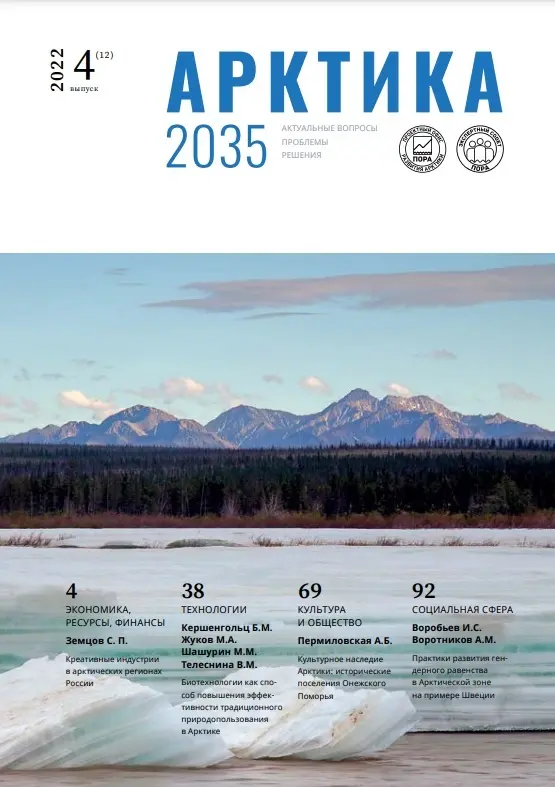
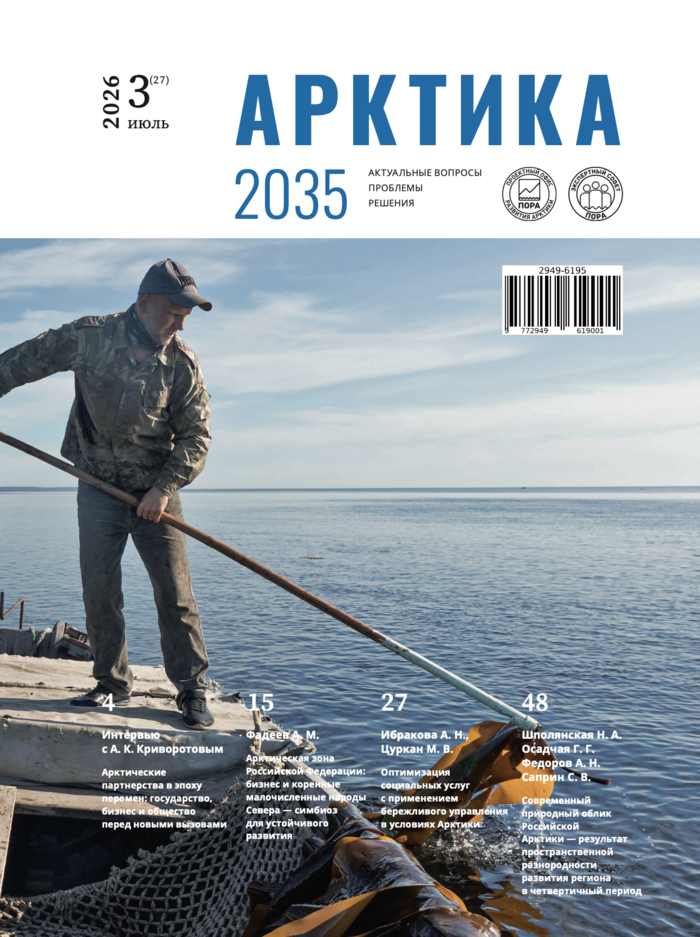
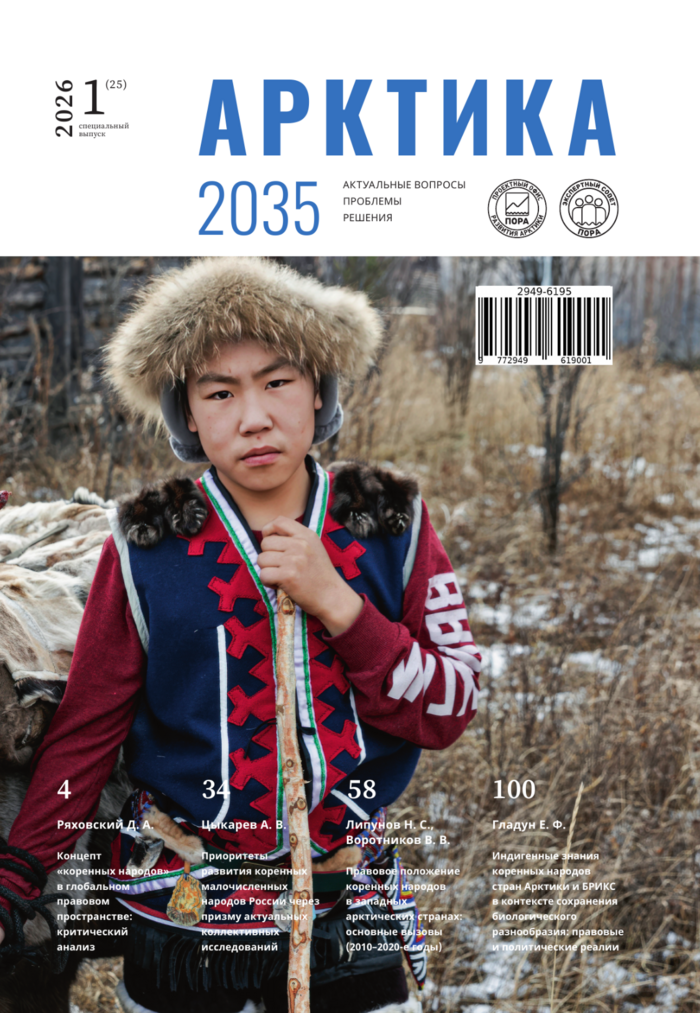
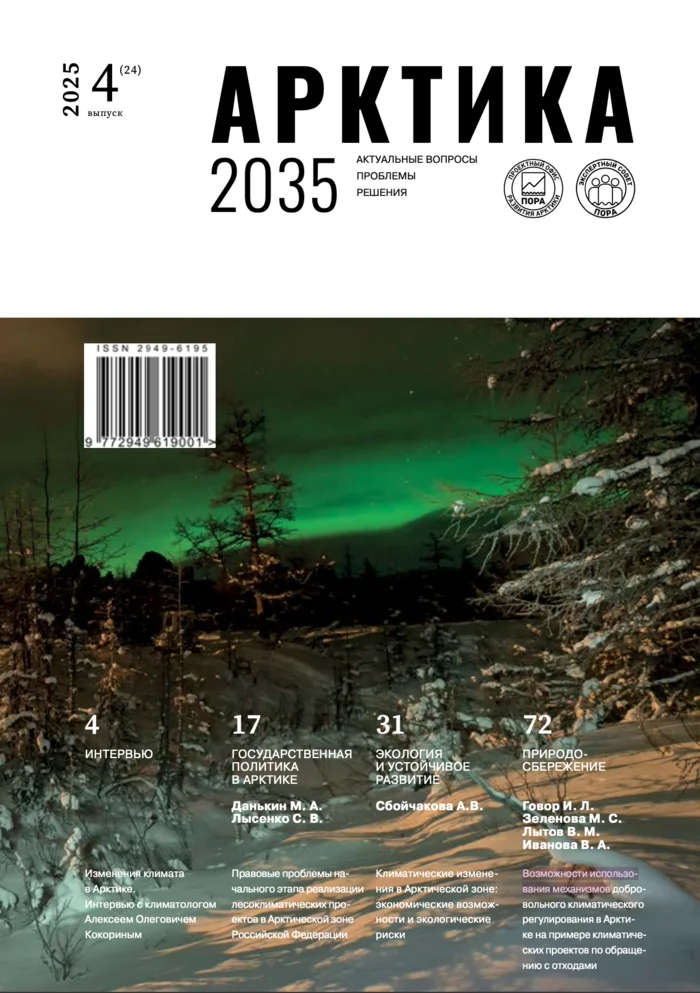
This issue contains both classic academic articles and practical ones. The authors propose solutions that can — and, we believe, must — be implemented and developed to make the Arctic an increasingly attractive place for doing business, living, and personal fulfillment.
In the Arctic regions, the costs of doing business are quite high. But such conditions determine the need for a unique specialization, while the rich cultural and scientific heritage and natural resources make it possible to develop certain branches of the creative industries: science, education, folk crafts, tourism, the film industry, etc. Today, the share of small and medium-sized enterprises of creative industries in the number of employees and company revenues is lower than in Russia on average due to the dominance of raw material corporations, but there is some potential. The article provides some examples of possible specialization of regions.
In the context of political, economic and other sanctions imposed against the Russian Federation, the primary task of state and municipal administration is to take measures aimed at ensuring socio-economic stability. The importance of self-sufficiency is increasing, primarily with food. Territorial, infrastructural, natural and climatic features of the Arctic zone of the Russian Federation, remote from the main industrial centers, cause a high dependence of economic activity and life support of the population of the territories on food supplies from other regions of Russia. The article analyzed the state, problems and trends of food security in the Arctic municipalities of the Republic of Sakha (Yakutia), including: analysis of the characteristic features of the socio-economic situation of the Arctic territories of the Republic of Sakha (Yakutia), affecting the level of food security; analysis of agricultural indicators; an analysis of regional policies aimed at providing food to the Arctic territories.
The article deals with the issue of transport and logistics support for energy projects implemented in the Arctic. Due to its unique geographical location, the issue of transport accessibility is key for most Arctic deposits. The existing prerequisites form the need to create a unified Arctic transport system, including aviation, maritime and railway infrastructure in order to increase transport accessibility in the Arctic. The ongoing projects in this direction (construction of new airports, modernization of seaports, creation of new helicopters, etc.) demonstrate a high degree of involvement of various parties in solving this issue. For further effective development, it is necessary to create institutional conditions that stimulate investment in infrastructure projects in the Arctic.
The article provides an organizational, economic, personnel and technological analysis of the state of traditional nature management in the Arctic. The authors come to the conclusion that biotechnologies of deep processing can and should become the economic and technological basis for increasing the efficiency of the basic sectors of traditional nature management. We are talking about the processing of highly active, environmentally friendly, renewable raw materials, including arctic wild plants. Here is an example of biotechnological developments of the UPS of the Federal Research Center “SSC SB RAS”. The authors considered the large-scale industrial production of biological products containing biologically active substances from the tissues of the reindeer, the Yakut horse, lichens and northern wild plants. Medical, food and cosmetology areas can become really profitable for the traditional sectors of nature management in the Arctic. At the same time, they are able to increase the adaptive potential of the population, the level of health and performance of the northerners, reduce the accident rate due to the “human factor” of shift workers and military personnel.
In the conditions of intensive industrial development of arctic regions and global climatic changes, the competition for territories between subsoil users, reindeer herding farms and herds of wild reindeer is sharply increasing. To eliminate the contradictions that arise, it is necessary to introduce reindeer husbandry monitoring systems based on the use of satellite constellations of various types. The article presents the principles of the creation of such systems, as well as describes hardware and software solutions that allow organizing permanent remote monitoring of movements and behavior of animals.
Based on the analysis of the specifics and problems of the Arctic zone of the Russian Federation, the article substantiates the necessity and expediency of project initiatives of the cyclical economy, presents a project for the thermal processing of organic waste of production and consumption and a scheme to achieve a “double” effect of its implementation, which allows reducing landfill areas and obtaining resources for renewable energy, which demonstrates its relevance for the Arctic; the next project initiative concerns the creation of mobile stations for processing various types of waste, which in the conditions of the Arctic zone will allow solving logistical problems arising from permafrost conditions; the possibilities of combining the proposed project initiatives are shown. In conclusion, the possibility of attributing the technologies of project initiatives of the cyclical economy to the best available technologies and the need for the expediency of their state support is noted.
The object of the study is folk architecture as the traditional Russian culture ethnomarker of in the process of historical development in the Russian North and the Arctic. The purpose of the work is to explore the Onega Pomorie historical settlements as unique ethno-cultural components of the region, reflecting the specifics of the Russian ethnic group in the Arctic. The study is based on the use of two author’s methods for the architectural and ethnographic examination of wooden architecture monuments and historical settlements as objects of cultural heritage. The technique was tested in 40 expeditions and published in an educational, scientific and reference manual, 6 monographs. Research work is based on expeditionary material, analysis of archival and museum sources, monuments of wooden architecture. In the course of the study, the following methods were used: ethnographic questioning, interviews, architectural and ethnographic research of architectural monuments, historical settlements with photographic recording and schematic measurements.
Domestic tourism is becoming an increasingly valuable activity for both organized travelers and independent travelers. However, Arctic tourism is still an expensive exotic, and ethnotourism in high latitudes seems to be the newest, most desirable and in demand. Its popularity is growing rapidly. This article suggests ways to increase the availability of ethnotourism and stimulate the development of the industry in the Krasnoyarsk Territory.
This paper reflects the key directions of the gender equality agenda in Sweden, which is a world leader in achieving equality and inclusion. As a circumpolar country, Sweden can serve as a model for other Arctic countries with less developed gender equality practices.