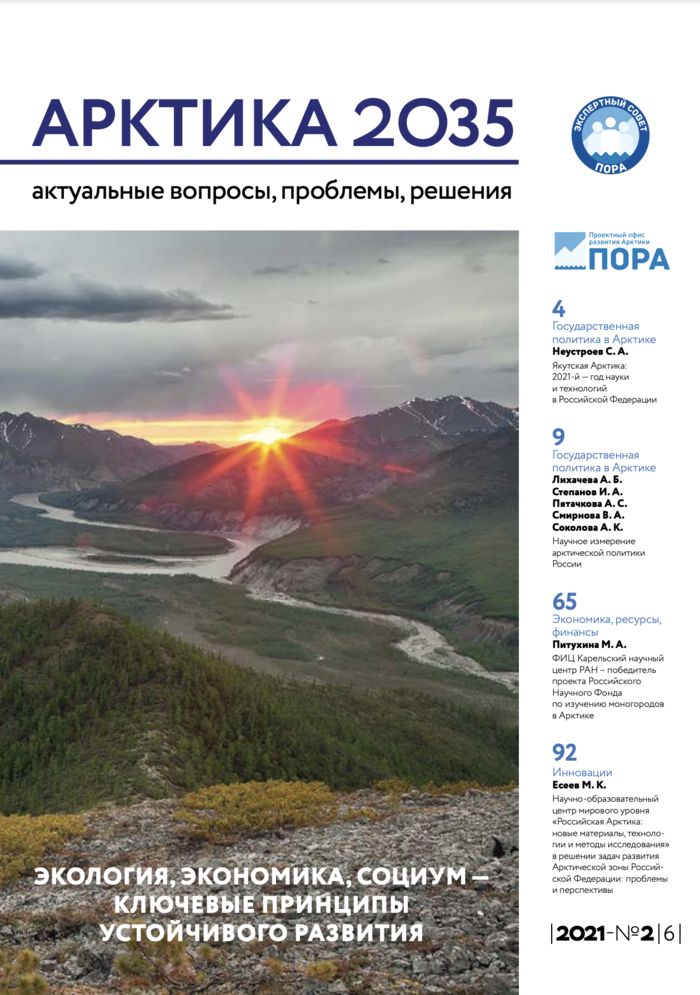
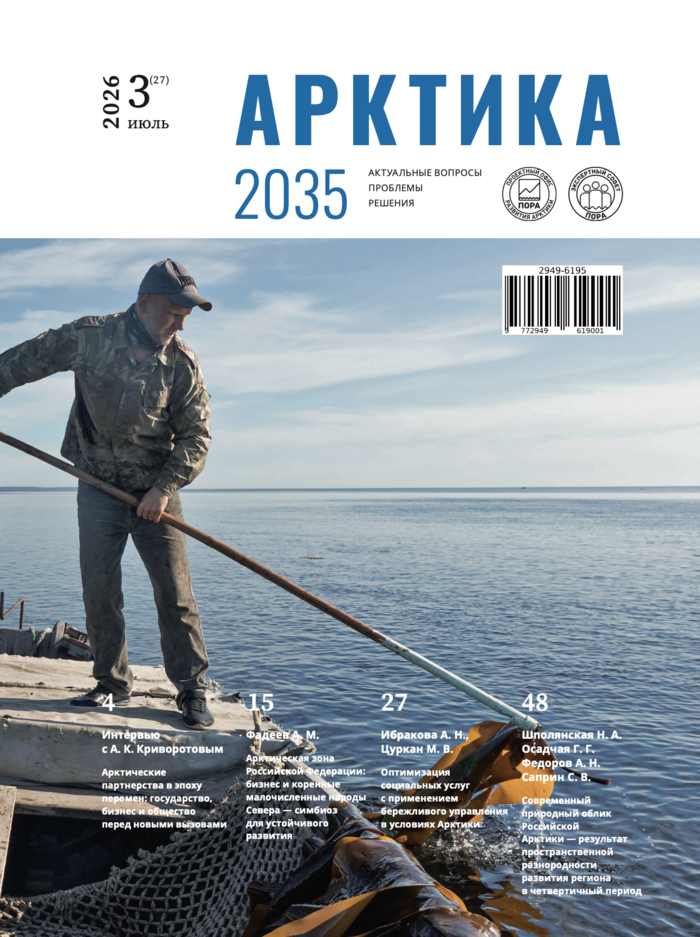
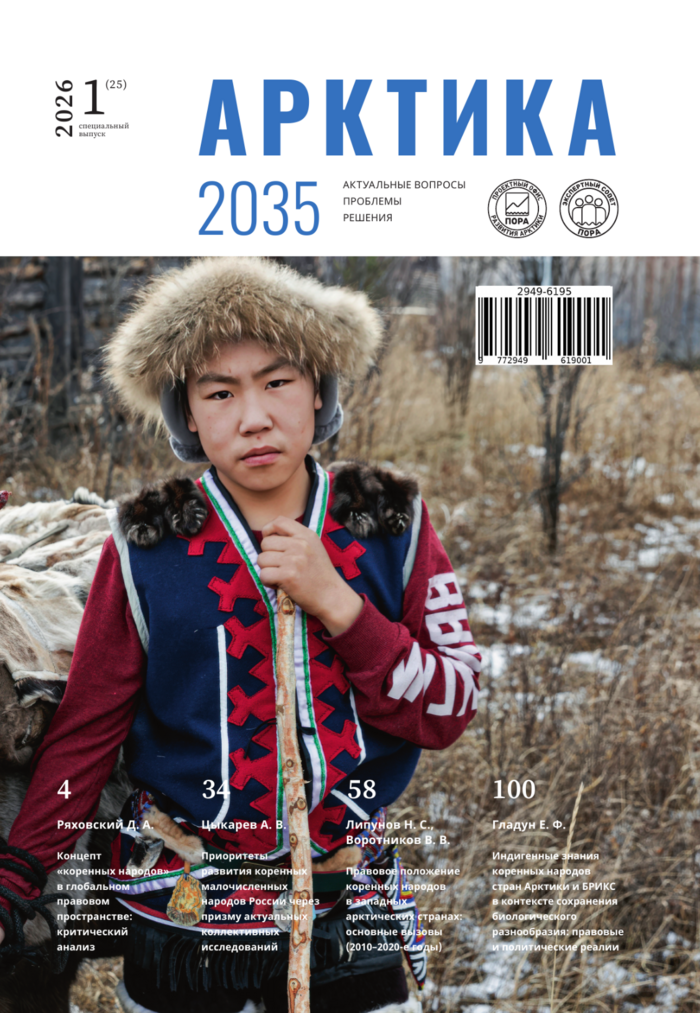
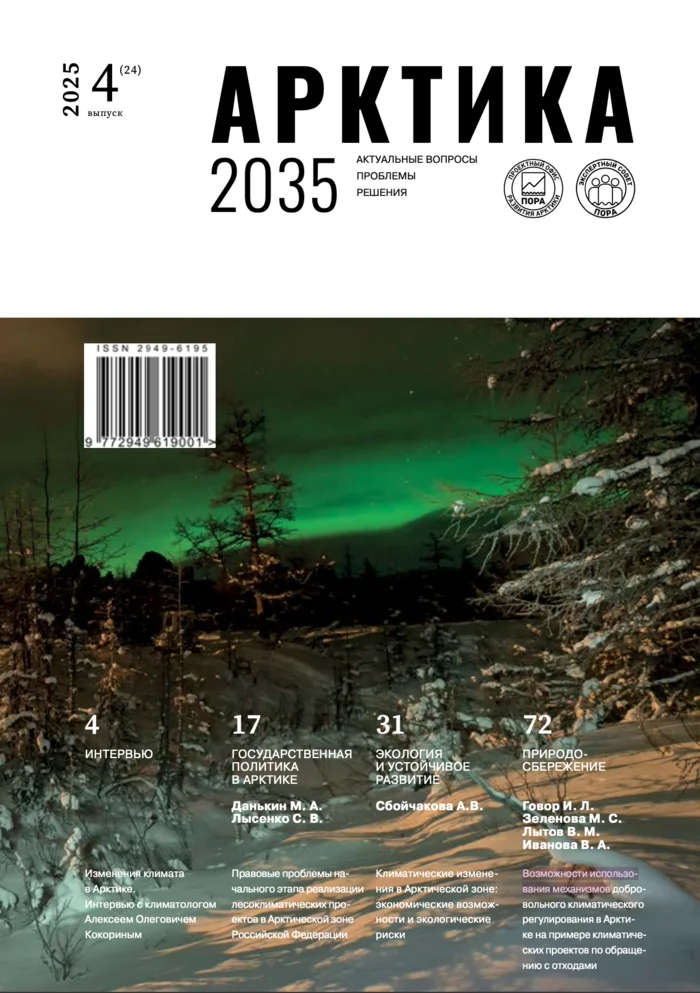
This issue is dedicated to scientific, innovative, and technological support for the development of the Arctic Zone of the Russian Federation. Considerable attention is paid to international scientific cooperation in the Arctic.
In the Arctic, with its territorial and climatic features, scientific achievements and developments are in great demand. The climatic conditions and the complex transport scheme of the hard-to-reach regions of the North and the Arctic cause significant differences in the living standards of the population and the costs of production activities.
The article considers the role of science in international cooperation in the Arctic and the setting of Russia’s foreign and domestic policy in the region. To date, the Arctic has become the world's main laboratory for studying the processes of climate change. A comprehensive understanding of the dynamics of climate change is becoming not only a tool for managing climate risks, but also increasingly the basis for the interpretation of the norms of international maritime law (in particular, the interpretation of Article 234 of the UN Convention on the Law of the Sea), and potentially the specific actions of stakeholders in the Arctic.
The paper examines several cases of scientific cooperation in the Arctic focusing mainly on China and Finland. China is a significant Russian foreign partner and simultaneously a new actor in the Arctic region which uses scientific diplomacy as an important tool to expand its influence in the region. Finland, in contrast, is a traditional partner of Russia in the region, sharing common interests for the Arctic countries.
The paper concludes that there is a need for a radical revision of the role of scientific research and its positioning in the state policy on the development of the Arctic. The task of ensuring the conditions for security and development in the Arctic requires a shift of Russian science from joining and catching up actor to the leading country that would involve other members of the international community into cooperation. This task also demands a significant increase in funding for the Arctic science, a revision of the existing institutional links between science, government and business. Besides, there is a need for the transition from an extensively exploitative to a raw materials innovative model of the development of the region, based on the principles of environmentally friendly high-tech development of the Arctic together with other regions of Russia, primarily Siberia and the Far East.
PROBLEMS AND PROSPECTS FOR THE DEVELOPMENT OF THE SCIENTIFIC POTENTIAL OF THE ARCTIC ZONE OF THE RUSSIAN FEDERATION ON THE EXAMPLEOF THE REPUBLIC OF SAKHA (YAKUTIA)
For example of the Republic of Sakha (Yakutia), which is part of both the Arctic zone (AZ) and the Far Eastern Federal District of Russia, a brief analysis of the formation of scientific potential in the North-East of Eurasia, starting from 1736 to the present, is carried out. An attempt has been made to highlight the main problems and obstacles to the development of the scientific potential of the Arctic zone of Russia at the present time. Some considerations were expressed regarding the development of scientific infrastructure in the RF AZ, the role of scientific and educational centers in the creation and promotion of new Arctic technologies, proposals regarding current research areas in the RF AZ, as well as measures that need to be implemented as soon as possible for the sustainable development of science in Arctic.
The article considers the paradigm shift in public policy and government's decisions on the exploration and socio-economic development of the Arctic zone of the Russian Federation as prerequisites for the formation of an integrated scientific research program in the Arctic, new approaches to solving practical problems as a system of related results of scientific research and public administration mechanisms of the development of geostrategic territories of Russia. The subject matter of scientific and applied problems is articulated on the example of ensuring the quality of life of the Arctic population.
The article presents an overview of scientific trends in the development of science on the example of the forms, methods and tools of the work of foreign scientific forces in the Arctic. Despite the fact that the practice of scientific forecasts and the development of priorities for scientific and technological development in different countries differs significantly in their approaches, but in general, futuristic ideas are based on the priorities of international cooperation in the scientific support of breakthrough solutions, the expansion of the use of information and communication technologies and interdisciplinary approaches.
The article presents an analysis of China's Concept for the Development of the Arctic. China's Arctic Concept is consistent with leadership in scientific research, emphasizes environmental protection, advocates environmental management, advocates legal governance and international cooperation, and aims to maintain a peaceful, secure and stable Arctic order. The Arctic concept of China is based on: constant scientific research and knowledge of the Arctic; protecting the ecological environment in the Arctic and responding to climate change; on the reasonable and rational use of the resources of the Arctic; on active participation in international cooperation in the Arctic; to promote peace and stability in the Arctic. The Arctic is melting, the economy and trade are getting easier, and China is expected to get a new "oil route". Once the development of the Arctic waterway and the unification "along the polar economic circle" are realized, it will bring: economic benefits, political benefits and strategic benefits associated with the expansion of China's global economic and geopolitical space in the next 30-50 years. Scientific research in China on the development of the Arctic lies in the plane of five key positions:
1) participation in projects for the extraction, processing and transportation of hydrocarbons;
2) development and use of the Arctic waterway;
3) development of renewable energy;
4) development of fishing;
5) development of Arctic tourism.
Analyzing the international cooperation of Institute of Northern Industrial Ecology Problems of Kola Science Centre of RAS (INEP) since establishing the Institute till present, the article advocates the nature protection issue as a natural base of science diplomacy development in the Arctic. Drawing on case study methodology, the article demonstrates how the "diplomacy for science" in beginning of perestroika serves as a stimulus for "science in diplomacy" and "science for diplomacy" practices development. INEP scientific research contributes Arctic sustainable development and is of interest in many Arctic countries. INEP's research directions are: Arctic biodiversity changing; methods for the damaged terrestrial ecosystems restoration and bioremediation of industrial dumps; creation of biotechnologies for the extraction of metals from poor ores and waste of enrichment and purification of environments from pollutants; interaction of society and nature. The aforementioned areas of research often serve as the basis of international projects. Having started its international cooperation with projects on environmental monitoring, INEP has risen to projects for regional and global decision-makers scientific advice development. International cooperation and creation of international scientific alliances contributes to improving the quality of environmental research as well as to improving relations between countries.
The Russian Science Foundation (RSF) project in the Republic of Karelia "Institutional engineering of monocities in the Arctic zone – modernization and sustainable development" is the winner of the RSF competition in 2021 among applicants for funds to support "Conducting fundamental and exploratory research by individual scientific groups." The Arctic is a traditionally interesting and relevant object from the point of view of its development, especially in the context of the concept of sustainable development in the context of the modern economic modernization agenda. In the context of globalization, in addition to business interests, socio-economic and natural factors, decision-making related to specific territories is increasingly influenced by structural transformations occurring in conditions of social, environmental or political turmoil. At the same time, it is resilience that has become a popular concept in regional studies. The development of single-industry towns (monocities) as special parts of the economic space has also become the focus of researchers. Including the development of single-industry towns in the Arctic zone.
PARTICIPATION OF THE SCIENTIFIC AND EDUCATIONAL CENTER «SEVER» IN THE IMPLEMENTATION OF THE STATE PROGRAM OF THE REPUBLIC OF SAKHA (YAKUTIA) «SCIENTIFIC AND TECHNOLOGICAL DEVELOPMENT OF THE REPUBLIC OF SAKHA (YAKUTIA) FOR 2020–2024»
At present, science is one of the most important components of the socio-economic development and competitiveness of the Republic of Sakha (Yakutia) and the Arctic zone of the Russian Federation as a whole, therefore it is necessary to develop mechanisms for the implementation of the main strategic documents for the development and improvement of scientific, scientific, technical and innovation spheres of activity. This article will consider the main tasks and directions of the state program of the Republic of Sakha (Yakutia) "Scientific and technological development of the Republic of Sakha (Yakutia) for 2020 - 2024" as a fundamental the document in solving many national and global problems, through the activities of the Scientific — educational center "North".
The article analyzes the new approaches set out in the Fundamentals of state policy in the Arctic zone until 2035 to use the capabilities of science and technology in the development and development of the Arctic, improving the defense capability of the Russian army. The importance of using international, including European experience in organizing and conducting scientific research is emphasized.
The authors consider innovative approaches to the development of offshore hydrocarbon fields in the Arctic: at present, the oil and gas complex has ceased to be technologically simple - the development of fields requires science and production to create a whole range of fundamentally new technical means, and development technologies, in terms of their complexity, are comparable to technologies space exploration and nanotechnology. Currently, such concepts as “smart field” and “smart well” have appeared in the professional vocabulary of Arctic researchers, largely reflecting the innovativeness and manufacturability of projects for the production of hydrocarbons on the shelf. Along with this, it is the activity of the oil and gas complex that fully corresponds to the state task of transitioning to an innovative path of development.
WORLD-CLASS RESEARCH AND EDUCATIONAL CENTER «RUSSIAN ARCTIC: NEW MATERIALS, TECHNOLOGIES AND RESEARCH METHODS» IN SOLVING THE PROBLEMS OF THE DEVELOPMENT OF THE ARCTIC ZONE OF THE RUSSIAN FEDERATION: PROBLEMS AND PROSPECTS
The idea of creating scientific and educational centers (REC) in Russia implies a completely new, innovative transformation of the Russian economy. This has no analogues in the history of the era of industrialization and post-industrialization, although it is based on the already known principles of integration by industry and / or cluster type. In the Scientific and Educational Center, the formation of four vectors of force is predetermined, capable of providing a synergistic effect for spatial development of territories with the coordinated activities of REC participants. REC in the Arctic can become a particularly important factor in scientific and technological development. The world-class REC “Russian Arctic: New Materials, Technologies and Research Methods” was selected on December 3, 2020 as a result of a competitive selection of the Ministry of Education and Science of Russia for solving social and economic problems and economic development of the Arctic territories on the initiative of the governors of the Arkhangelsk Region, the Murmansk Region and the Nenets Autonomous Okrug.
In 2019, Russia ratified the Paris Agreement. For its successful implementation, it is necessary to develop a methodology for measuring the fluxes of the balance of the main greenhouse gases, namely, how and where they are released and absorbed. For this purpose, the Carbon project was launched. The article shows the necessity of this project and the importance of its implementation in the Arctic zone of the Russian Federation.